KELLOW | 1903-05 | Australia :
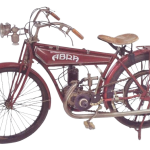
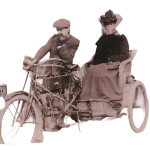
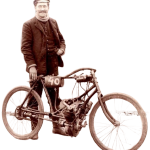
Charles Brown Kellow was a successful cyclist who won the prestigious Austral Wheel Race in 1896, and shortly after the turn of the century raced motorcycles. The Austral Wheel Race, arranged by the Melbourne Bicycle Club and run on the grass at the Melbourne Cricket Ground, was by the 1890s the most valuable cycle race in the world and attracted cyclists from around the world. Winning it placed Kellow among the most celebrated sportsmen in Victoria, and the competitive instinct and mechanical awareness he developed as a racing cyclist carried directly into the businesses he would pursue afterwards.
A note on the name: Henry Brown Kellow changed his name by deed poll to Charles. He was born in 1871 at Sutton Grange, Victoria, and it was under the name Charles Brown Kellow that he built all of his commercial and sporting reputation.
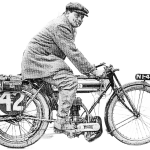
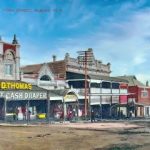
He ran a bicycle business in Swanston Street, Melbourne, with W. Howard Lewis, assuming sole ownership around the turn of the century. The business was established in 1889, and was operating from 154 Swanston Street by 1903. It was from these premises that the Kellow motorcycle emerged. An advertisement in The Age on 7 February 1903 described the offering as “KELLOW Motor Cycles and Bicycles,” with Kellow styling himself as manufacturer at 151 Swanston Street. He also advertised Humber and Werner motor cycles alongside his own Kellow machines.
Kellow had already imported and demonstrated a Darracq car early in 1901, and during the railway strike of 1903 he delivered Melbourne newspapers to country towns. That same year, the motorcycle business was advertising in the press. Early in 1904 the business moved to larger premises in Lonsdale Street.
The pivot to automobiles came quickly and decisively. By 1904 he was importing Wolseley cars, and in 1905 he was racing motor cars, first a Talbot and then a Napier, for which he became the agent. In 1904 he landed a shipment of ten cars, eight of which were sold within two days. Motorcycles took a back seat. In 1905, with Harry James, he set a 24-hour endurance record of 556 miles in a 12 horsepower Humber, and they made a record-breaking Melbourne to Sydney run of 25 hours 40 minutes in 1908, driving a 15 horsepower Talbot. C.B. Kellow’s Melbourne to Sydney record stood until December 1909, when it was broken by four hours.
Later he formed the Kellow-Falkiner company, which in 1914 was selling Overland, Minerva, Wolseley, Standard, Talbot, Renault, Albion and Rolls-Royce at premises in Bourke Street and Russell Street. In the 1920s they had showrooms at 379 St. Kilda Road, Melbourne, which could only be described as fittingly palatial for the luxurious automobiles they displayed. The former Kellow-Falkiner showrooms, built for Kellow in 1928, still stand as a heritage-listed building.
Kellow’s later years saw him extend his competitive interests into horse racing. He purchased the champion stallion Heroic, and bred the 1933 Melbourne Cup winner Hall Mark. Kellow died of heart failure at his South Yarra home on 2 July 1943. His estate was sworn for probate at £147,229. The Kellow motorcycle, a brief episode at the start of what became one of Melbourne’s great motoring dynasties, was no more than a footnote in a life driven by speed in all its available forms.