KELLER | 1930-32 | Switzerland :
Karl Victor Keller was born in 1896 and died in 1961. He ran a motorcycle business at Ausstellungsstrasse in Zurich, where he sold FN and ACE motorcycles. FN, the Belgian manufacturer Fabrique Nationale de Herstal, had been producing motorcycles from 1901 to 1967, and was known for shaft drive, four-cylinder engines, and success in both sprint and long-distance racing. ACE, the American manufacturer, had built a reputation for large-capacity four-cylinder machines before being absorbed into Indian. Keller’s dealership in Zurich therefore represented the top end of the market, machines known for engineering quality and refinement rather than cheap utility transport.
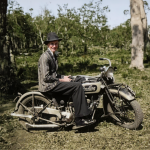
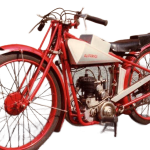
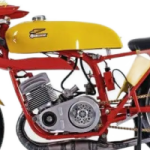
From that dealership background, Keller moved to manufacture. He built a motorcycle with a 397cc sidevalve engine of unit construction with an aluminium crankcase and a cast-iron cylinder head. The 19-inch wheels were painted bright red, spokes, nipples and rims. Only one model was produced, and although attractive with its clean, neat and very Swiss design, it proved too expensive for the market, which was in free-fall.
The corporate vehicle for the project was Kel-Cha Motor AG, based in Camorino in the canton of Tessin, which operated from 1929 to 1932. The Kel-Cha name combined elements of Keller’s own surname with that of a partner or associate, though no further detail about the other party survives in the available record. The choice of Camorino in Ticino as the registered location, while Keller himself operated from Zurich, suggests a separation between the commercial dealership and the manufacturing entity.
The timing could hardly have been worse. The Great Depression hit Switzerland relatively late, but when it arrived the economy did not recover until 1937. National income fell by almost 20 percent as a result of the crisis, and in the winter of 1936 the unemployment rate spiked at seven percent of the workforce, even higher in industrial regions. Switzerland was also known for its staunch defence of the gold standard and the rise of corporatist policies, and the long adherence to the gold standard proved costly for growth throughout this period. In this environment, a well-made but expensive domestically produced motorcycle had almost no chance of finding a market.
The Keller stands as a characteristic casualty of its moment. The engineering was considered, the presentation distinctive, and the unit-construction sidevalve design represented a thoughtful approach to a compact and serviceable machine. But the ambition of the project and the cost of Swiss manufacture, brought together precisely as the economic floor dropped away, meant the marque lasted only two years before disappearing entirely from the record.