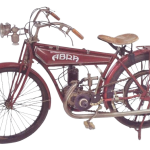
KR | 1924-25 | Germany : KR motorcycles were produced in Germany from 1924 to 1925. The company built lightweight motorcycles using 142cc and 195cc two-stroke engines of their own manufacture. Specific details about the models and production are
KR | 1901-34 | Germany To understand the Victoria KR 50 and KR 50 S, you first need to understand the company that made them, because the KR designation was not simply a model name but a thread running
KRAM-IT | Early 1980s-late 80s | Italy : Kram-It carried the German Kramer name across the Alps and into Italian hands. The operation began towards the end of the 1970s at Arcore, north of Milan, where it first imported the
KRAMER | Early 1970s-1984 | Germany : The Kramer marque grew out of a motorcycle business in Laubus-Eschbach, in the Taunus hills of Hesse, that had been founded by Fritz Kramer’s father. Fritz Kramer ran the firm as
KRAMMER | 1923-29 | Austria : Krammer was the work of one Viennese craftsman rather than a factory. The marque was built by the Mechanische Werkstätten Rudolf Krammer in Vienna, active from 1923 to 1929, producing high-quality bespoke motorcycles
KRASNY-OKTOBR | 1930-39 | Russia : Built in Leningrad and arriving ahead of the later Ural, Dnepr and Izh marques, the L-300 was the first mass-produced Russian motorcycle, powered by a 293cc single-cylinder two-stroke engine. The design was not
KRAUSE | 1954-91 | Germany : The Krause story begins in 1880, when Louis Krause founded his company and set it on a path that would eventually make it one of East Germany’s most distinctive vehicle manufacturers. By around
KRAUSER | 1980-mid 80s | Germany : The man behind the marque came to motorcycle building through racing and accessories rather than the other way round. Michael Krauser, known as Mike Krauser, was a highly successful sidecar racer for
KREIDLER | 1951- | Germany : Kreidler began life far from motorcycling, as a metalworking concern. It was founded in 1903 as Kreidlers Metall- und Drahtwerke, a metal and wire factory, by Anton Kreidler, was based in Kornwestheim between
KRIEGER (ORIGINAL KRIEGER) | 1925-26 | Germany : Once the KG brand had passed out of their hands, the Krieger brothers tried again under their own name. After the KG marque was taken over by Allright, the brothers Peter,
KRIEGER-GNÄDIG (KG) | 1919-32 | Germany : The marque was born out of aviation rather than the cycle trade. The Krieger brothers, Karl, Oskar, Max and Peter, lived in Berlin around the turn of the century, three of them
KRM | 1973-76 | UK : KRM stood for Kingston Racing Motors of Hull, and the firm built a single ambitious racer in 1973. A racing four was shown early that year at a London show, and in the
KROBOTH | 1950-55 | Germany : The marque was the work of one displaced engineer rebuilding a career from scratch. Gustav Kroboth, who lived from 1903 to 1984, had already built motor vehicles before the Second World War at
KRS | 1921-26 | Germany : KRS was a German assembler of the early 1920s that, like many small firms of the period, built its machines around bought-in proprietary engines rather than designs of its own. Manufactured from 1921
KRUPKAR | 1904 | UK Germany : Krupkar was not a manufacturer in any real sense but a rebadging scheme run from London. Krupkar was a German automobile marque offered only in 1904 by the British importer Morrison in
KRUPP | 1919-21 | Germany : This was a brief civilian sideline by one of Germany’s largest industrial concerns rather than a true entry into motorcycle building. As the largest German arms manufacturer, Friedrich Krupp AG of Essen switched