KREIDLER | 1951- | Germany :
Kreidler began life far from motorcycling, as a metalworking concern. It was founded in 1903 as Kreidlers Metall- und Drahtwerke, a metal and wire factory, by Anton Kreidler, was based in Kornwestheim between Ludwigsburg and Stuttgart, and only started to build motorcycles in 1951. The turn to two-wheelers was driven by the founder’s son. Alfred Kreidler, an engineer, joined the firm in 1924, took over its management when his father died in 1942, and from 1949 began developing motorcycles under the Kreidler name, leading in 1951 to the K50, produced in cooperation with Rex as one of the first powered 50cc two-wheelers and an effective forerunner of what would later be called the moped. The K50 ran a 50cc engine of around 2 to 2.2 horsepower with a two-speed gearbox and a top speed of roughly 50 to 55 kilometres per hour.
The model that made the name was the Florett. The first Florett, the K54, appeared in 1957 with a horizontally mounted single-cylinder two-stroke engine and fan cooling, grew into the best-known Kreidler model, and was offered in many forms, from pedal mopeds and speed-limited mokicks to the unrestricted GT and, from 1967, the sporting RS, which by 1980 produced up to 6.8 horsepower. Kreidler built mopeds, mokicks and small and light motorcycles of 50 to 80cc until 1982. The marque’s standing in its home market was considerable. By 1959 one third of all German motorcycles were Kreidlers. Their popularity rested heavily on a reputation for reliability, reinforced by the many 50cc speed records the machines set.
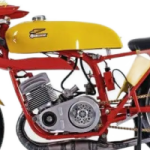
In competition Kreidler became one of the defining names of the smallest racing class. The firm took part in the 50cc World Championship from its inception in 1962, at first using motors based on its production Florett, and rider Hans-Georg Anscheidt finished a narrow second to Suzuki’s Ernst Degner in 1962 and to Hugh Anderson in 1963. The Dutch importer Van Veen took over the racing effort in 1965, after which a long run of championships followed, with Jan de Vries taking the title in 1971 and 1973, Henk van Kessel in 1974, Angel Nieto in 1975, Eugenio Lazzarini in 1979 and 1980, and Stefan Dörflinger in 1982 and 1983.
The end came through a combination of regulation and finance. German law changed in 1980, replacing the 50cc class with an 80cc class for which a licence was required, which worked against Kreidler, and the company closed its factory doors in 1982. The brand itself outlived the original firm through several hands. After the 1982 collapse the trademark rights were sold to the businessman Rudolf Scheidt, who had the Italian manufacturer Garelli make mopeds under the Kreidler name until 1988, after which the rights passed to the bicycle maker Prophete, with the brand used by its subsidiary Cycle Union of Oldenburg. Production of models with combustion engines was discontinued in 2017, both companies filed for insolvency at the end of 2022, and today the firm New Cycle produces e-bikes and bicycles under the Kreidler name.