KRIEGER-GNÄDIG (KG) | 1919-32 | Germany :
The marque was born out of aviation rather than the cycle trade. The Krieger brothers, Karl, Oskar, Max and Peter, lived in Berlin around the turn of the century, three of them technically gifted and Peter commercially minded, and in the years before the war they experimented with building aircraft with real success, until Karl lost his life in a test flight at the end of the conflict. Karl had been an aviation pioneer whose employer, Kaiser Wilhelm II, donated an engine for his first aeroplane, and who received pilot’s licence number 113 in 1911. With aircraft no longer in demand after the war, the surviving brothers turned their efforts to the design of an innovative motorcycle, met the designer Franz Gnädig, who joined the business, and bought a factory in Suhl in December 1919.
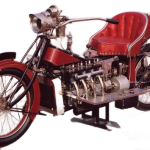
The machine they produced was unusually advanced for its moment. They developed a first series of six test models, ready by April 1920, fitted with overhead inlet and side exhaust valves, while the definitive design used a full overhead-valve engine of 80 by 99 millimetres and was the first German motorcycle with shaft drive. Other modern features included dry-sump lubrication, a very stiff triangular frame, quickly detachable and interchangeable wheels, and a three-speed gearbox set in line with the engine, with the early cast-iron-piston machines good for 75 kilometres per hour at 3,000 rpm and later aluminium-piston versions safe to 4,300 rpm.
For a brief period the firm thrived on merit before economics caught up with it. A celebration marked the hundredth machine in June 1921, and the Kriegers proved successful in races and reliability trials, but the innovative and luxurious KG was very expensive to build and the factory soon ran into financial trouble. The design then passed through a chain of owners.
Amid the economic chaos in Germany in the early 1920s, KG was absorbed in 1922 by Cito of Cologne, which continued the machine as the Cito-KG, Cito was acquired by Allright in 1923 and the motorcycle rebranded as the Allright-KG, and after the factory dropped it from the range, construction continued in small numbers. That later production was carried on by Paul Henkel of Mäbendorf near Suhl until 1932, so the design’s full lifespan under various names ran from 1919 to 1932.