KELLY | 1921 | UK :
Kelly was a motorcycle produced in 1921 by Kelly Patent Cycles of Black Lion Street, Brighton, Sussex. It arrived at a moment when the British motorcycle industry was crowded with small, short-lived ventures. British motorcycle registrations hit 373,000 in 1921, compared with 154,000 in the USA, and the post-war demand for cheap personal transport had encouraged dozens of small operators to attempt manufacture. The Kelly was one of them.
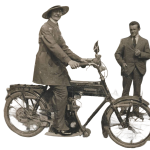
The Kelly, made for only a few months in Brighton, might be described as one of the new-fangled scooters or as a lady’s frame lightweight motor cycle. This very primitive design had an unconventional open frame. The open or step-through configuration was not entirely unusual for the period, as manufacturers were experimenting with designs intended to appeal to riders who wanted easier mounting and dismounting than a conventional diamond frame allowed, but the Kelly’s execution of the concept was far from refined.
For its engine, the Kelly used a 318cc two-stroke Dalm unit and a two-speed Sturmey-Archer gearbox. The Dalm engine was produced by J.C. Dalman and Sons of River Street, Birmingham. Following the success of the Levis two-strokes commencing around 1911, quite a number of imitations were designed and brought to market from around 1913, and the Dalm was one of these. In England, Dalm engines powered about a dozen makes of motorcycles of considerable obscurity at one time or another. The popular Levis engine was of 211cc; the Dalm was exactly 50 per cent larger at 318cc. Construction was similar to the Levis engine although heavier and stronger, with all bronze bearings and a bolted-up big end. Production of the Dalm engine ceased in the financial slump of 1922. The Sturmey-Archer TS lightweight two-speed gearbox was supplied to a variety of vintage motorcycle makers, and years of production ran only from 1920 to 1923.
The Kelly’s approach to rider comfort was unusual. The machine was sprung by means of a leaf spring together with the rider’s saddle and a rear carrier, to give insulation from road shocks. The idea of isolating the rider from vibration and road surface through a sprung saddle arrangement rather than frame suspension was not unprecedented, but the particular manner in which the Kelly implemented it contributed to its problems.
The model was tested by a reporter from a specialist magazine and found to be unstable, as the drive became deranged. That single published road test appears to represent the sum of the Kelly’s documented public life. The company name, Kelly Patent Cycles, suggested that proprietary protection had been sought for some aspect of the design, though whether that related to the frame configuration, the springing arrangement, or some other feature is not recorded. Whatever the patent covered, it did not produce a viable machine, and the venture ended as quickly as it had begun.