KITAGAWA | 1959-59 | Japan :
The Kitagawa Motor Company belongs to one of the most compressed and turbulent chapters in industrial history: the explosion of Japanese motorcycle manufacturing in the decade following the Second World War, when the number of motorcycle producers in Japan reached over two hundred before the inevitable and rapid consolidation reduced that number to a handful.
In the 1950s when Japan was first embarking on the road to recovery, there were countless companies entering the motorcycle industry. At one point the number of companies swelled to 204. However, a shakeout had already begun by the time Yamaha suggested producing motorcycles. Kitagawa was one of those companies, and its story encompasses both the ingenuity of the era and the broader pattern of foreign-inspired engineering that characterised the period.
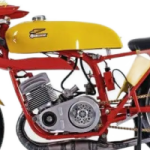
Originally founded in 1948 as a frame and body panel company, manufacturing started in 1950. 150cc engines were brought in from Fuji Sangyo for the Portly Robin. At some point engine manufacturing was brought in-house and two other models are listed: the 1953 Portly Liner, which was an OHV four-stroke, and the 1955 Liner Crown, a 125cc OHV four-stroke.
Fuji Sangyo was a significant name in postwar Japanese industry. Fuji Sangyo Co. Ltd had reorganised from Nakajima Aircraft Co., one of Japan’s major wartime aircraft manufacturers, switching to production of consumer products in 1945. The Silver Pigeon and the Rabbit motor scooter manufactured by Fuji Sangyo dominated the vehicle industry and both became convenient means of transportation for ordinary people who had lacked adequate transportation. Kitagawa’s decision to source initial engines from this established and capable supplier was a practical route into powered two-wheeler production for a company whose core competence was structural metalwork.
The most ambitious phase of Kitagawa’s development came through direct study of a British machine. In 1953, four Sunbeam S7 motorcycles were purchased from the UK and a new line of machines patterned after the Sunbeam design was on the market in 1955. These included the 250cc Liner TW and Liner TW II, and the Liner TW III in 1957.
The Sunbeam S7 that served as the template was itself an unusual machine in the British context. The Sunbeam S7 was designed by Erling Poppe with styling loosely based on BMW R71 designs acquired as war reparations by BSA. The engine was a longitudinally mounted inline vertical OHC 500cc twin with coil ignition and wet sump lubrication which, through a dry clutch, drove a shaft drive to the rear wheel. The early S7 was expensive and over-engineered, which is why it now commands a premium. For Kitagawa, the appeal of the Sunbeam’s configuration was its modernity: shaft drive, overhead camshaft, enclosed running gear, and a generally automotive approach to engineering set it apart from the belt-drive primitives still common in the Japanese market. Scaling the concept down to 250cc for a domestic market where smaller displacement was both economically and practically appropriate was a logical adaptation.
The practice of purchasing foreign machines for reverse engineering was widespread in Japan during this period. Japan’s freedom to copy foreign motor vehicle designs during the transwar era characterised the industry’s development, as did significant efforts to reverse-engineer foreign designs alongside unique cases of technology transfer. Kitagawa’s purchase of four S7 machines was a deliberate investment in understanding what the Sunbeam had to teach.
Kitagawa Motor Co. Ltd. joined the Yamaha Motor group in 1959. By that point Yamaha, founded as a motorcycle company in 1955 from Nippon Gakki’s piano-making heritage, had established itself firmly enough to absorb smaller producers. The Kitagawa marque, which had moved from bought-in engines to in-house four-stroke development to a Sunbeam-inspired shaft-drive twin in under a decade, ended its independent existence as one of the many casualties of the consolidation that was creating Japan’s Big Four.