KIRMER | 1913-17 | UK :
The Kirmer name is a contraction of the two surnames behind it, and the story it represents is a characteristic episode from Birmingham’s two-wheeled industrial history: a long-established cycle firm making a cautious and ultimately brief venture into powered machines during the years when the motorcycle industry seemed to offer a credible expansion of an existing bicycle business.
Kirmer motorcycles were produced from 1915 to 1917. The name was derived from that of the makers, Kirk and Merifield, of Bradford Street, Birmingham, who had been building bicycles since 1893. Bradford Street in Birmingham was already notable in motorcycle history as the address where James Lansdowne Norton had established his company in 1898, and the street lay within the dense cluster of engineering and cycle trades that made Birmingham the practical centre of the British lightweight vehicle industry in these years.
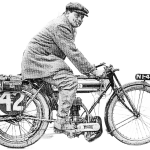
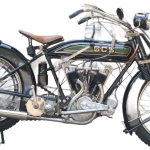
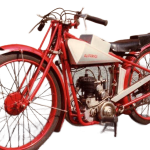
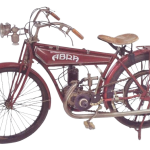
In 1913 Kirk and Merifield started making bicycles under the Kirmer name and motorcycles under the Arrow name. These motorcycles were produced from 1913 to 1917. The motorised version was powered by a 211cc two-stroke engine from Levis or Precision, and had a simple transmission and Chater-Lea fittings.
The engines available to the firm represented the two most prominent Birmingham two-stroke suppliers of the period. The first Levis was made in the Norton works by designer Howard Newey, who then joined with the Butterfield family to set up a motorcycle company. Their first model had a capacity of 211cc. In 1916, the 211cc vertical two-stroke engine produced 3hp, with an enclosed chain from the crankshaft driving the Fellows magneto and drive to the rear wheel by Pedley Vee belt. The machine weighed approximately 120 pounds. The Precision engine came from F.E. Baker Ltd of Moorsom Street, Birmingham, a prolific engine builder who supplied engines to a wide range of manufacturers and whose Precision engines were used across the British motorcycle trade.
The Chater-Lea fittings that completed the Arrow and Kirmer machines were a respected Birmingham proprietary component, and their presence indicates that Kirk and Merifield were assembling from quality parts rather than the cheapest available suppliers.
After 1915 the machine was also sold, mainly in Australia, under the Kirmer label with a two-speed Burman gearbox. The specific fitment of the Burman gearbox for the Australian export market suggests a deliberate specification for a market where the added flexibility of two speeds would have been valued for the varied terrain. A surviving unrestored 1912 Kirmer was brought to Kingaroy in Queensland by John Pettigrew of Shepparton in Victoria, and is thought to be the only example left in the world. Its survival in Australia rather than Britain is consistent with the known pattern of export to that market.
Production ended in 1917, as wartime conditions made civilian motorcycle manufacture increasingly impractical for small assemblers. Kirk and Merifield continued as a bicycle firm, and in 1931 bought the Swift Cycle Co name and moved Swift’s production to their Birmingham factory. The company was still operating at Macdonald Street, Birmingham as proprietors of the Swift Cycle Co in 1940. The motorcycle chapter of their history was therefore four years of a business life that extended across at least half a century.