KEW FLYER | 1912-16 | Australia :
The Kew Flyer is one of those Australian marque names that sits as much in local social history as in the history of motorcycle manufacture, and its story begins not with an engine but with a bicycle shop and a road race.
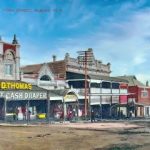
In 1903, an article in the Box Hill Reporter noted that the Kew Flyer Cycle business had been started in 1893 by Harry F. Cooper, who was described as the oldest cycle maker in the district. By 1903 the Kew Flyer business was located at 8, later 14, Cotham Road, where it was to remain an institution until its closure. The premises sat opposite the Kew Post Office and became a fixture in the commercial and sporting life of the suburb.
The annual road race that Cooper established was an important part of local cycling culture. W.D. Vaughan, in his Jubilee History of Kew, Victoria, written in 1910, noted that several cycling clubs had been born and died, suffering chiefly from the migration of their leading spirits, but that since 1900 the Kew Flyer road race, instituted by Mr H.F. Cooper, had been the cycling event of the year among local riders. It was run on the White Horse Road at Blackburn. Early newspaper reports record the distance of the race as initially ten miles, but by 1906 the event was fifteen miles, starting from the Travellers’ Rest Hotel in Blackburn. By 1914 the race had been running for thirteen consecutive years, an unbroken record of community sporting patronage.
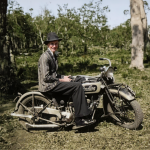
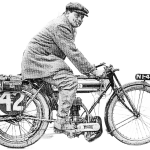
Cooper’s Kew Flyer business in Cotham Road introduced new technologies and models throughout its operation. By 1908, it was claimed that the shop had been enlarged with new workshops and the latest lathes and cycle building tools, and was now one of the most up-to-date cycle works in Victoria. By the First World War, Cooper had expanded his business to include motorbikes with Precision Engines. The Precision engines referred to were the products of F.E. Baker Ltd of Birmingham, whose Precision trademark was widely used by motorcycle assemblers across Britain and the Commonwealth. F.E. Baker had a thriving export business, especially to Australia, and many manufacturers used the Precision trademark as part of their model names. For Cooper, adding Precision-engined motorcycles to his established bicycle trade was a natural extension into the powered transport that his cycling customers were beginning to adopt.
The Kew Flyer business and the annual road races continued through the war, even though a number of its staff left for the front. One of these was Private Robert Charles Field Richardson, who joined the 6th Battalion, fought and was wounded at Gallipoli, and died of wounds in Alexandria, Egypt in 1915. In 1917, the death of Private H.S. Herbert was announced. He had been the winner of the Kew Flyer Cycle Road Race in 1913. He died in action in France, having fought at Gallipoli and at the Battle of Pozières.
The Kew Flyer motorcycle was therefore never a manufacturer’s marque in the industrial sense. It was a local trade name applied to machines assembled from imported components by a long-established cycle dealer who had served his suburb’s riders for more than two decades before the first Precision-engined machine left his Cotham Road workshop. That the business continued to sponsor its road race throughout the war years, even as the men who had ridden and worked there were dying in Gallipoli and France, gives the name a weight that a simple list of engine specifications cannot convey.