KERRY | 1902-14 & 1960-67 | UK :
The Kerry is among a small group of British motorcycle marques whose story spans more than six decades, not through continuous production but through the persistence of a commercial name that outlasted the industry conditions that originally created it.
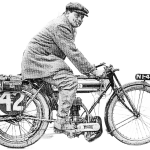
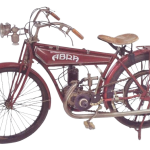
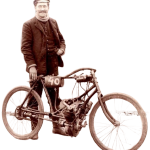
The name belongs to the East London Rubber Company of Shoreditch, a wholesale merchant house that operated under the direction of Alfred Kerry. The company under the direction of Alfred Kerry sold motorcycles fitted with Belgian Kelecom and FN engines in a loop frame with curved downtube, with frames made by other suppliers. As a high-built primitive it had belt drive and braced forks. Engines were of different sizes and there was also a ladies’ model. The East London Rubber Company chose the Kerry name for motorcycles manufactured on its behalf by the Belgian Sarolea concern, using re-branded Kelecom and FN engines, from 1902 to 1906.
The Sarolea business had been founded in 1850 in Herstal, Liège, by Joseph Saroléa, as an arms manufacturer, the company eventually moving onto producing bicycles in 1892, which like many other firms in Europe and the UK then evolved into motorised versions. In 1912, Saroléa’s catalogue boasted that it was the oldest motorcycle manufacturer in Belgium and had a sales figure of over 10,000 bikes. The early Kerry motorcycles were therefore products of one of the most experienced manufacturers in Continental Europe, sold in Britain under a domestic name to suit the preferences of the English market. The 1903 Kerry employed a moped-type pedal starting system that disengaged once the motor started running, and braking was achieved by setting the pedal shafts parallel to the ground and pressing down on the rearmost pedal like a fixed-wheel bicycle.
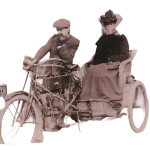
The commercial arrangement changed following Alfred Kerry’s death. After the death of Alfred Kerry the parent company, East India Rubber, was acquired by Abingdon, and the firm added V-twins to the range. Soon, using those engines, they were sold as the Kerry-Abingdon, with models including those fitted with a 3hp single and a 6hp V-twin. At around this time the company joined with the East London Rubber Co to make Kerry-Abingdon motorcycles for that firm, who bought and sold in preference to manufacturing. This arrangement continued until 1915. A neat 3.5hp model was produced, soon followed by a 6hp V-twin, both belt-driven and with a three-speed rear hub. There were also two large singles of 499cc and 623cc. The company built its own engines and these were later supplied to other firms including Rex-Acme and Ariel. Kerry also established a substantial sidecar business alongside the motorcycles, producing sidecars from 1905 or earlier, and offering fifteen sidecar models by 1914. Production halted in December 1915 as wartime conditions ended civilian manufacture.
The company itself continued as a broad wholesale and motor trade merchant. In 1934 the East London Rubber Company floated as a public company employing 450 staff. During the Second World War it had three engineering shops working for the Ministry of Supply, undertaking work including making cold-starting equipment for Russian tanks and jib cranes for removing tank engines. In 1943 the name changed to Kerry’s (Great Britain) Ltd, the company having absorbed the Kerry identity so completely that the founder’s name became the corporate name.
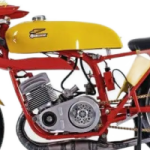
Having not sold a motorcycle under its brand for 46 years, Kerry re-entered the motorised market in July 1960 with a two-speed moped. The Kerry name reappeared at the end of the 1950s selling rebranded Italian scooters and mopeds, earning the company the dubious laurel of the longest production hiatus between models. Returning to established practice, the Capitano was a factored machine, built in Italy by Testi and imported complete with a cast Kerry badge plate on the clutch case of the Minarelli motor, which was a standard service feature of this engine supplier for factored customers, with Kerry decals simply applied to the petrol tank.
The Minarelli engine of the Capitano was rated at 3.1bhp at 5,000rpm, making it the most powerful moped on the UK market. At the time, Phillips and Norman were fitting the 2bhp Villiers 3K motor, NSU’s Quicklys managed only 1.4bhp for the two-speed and 1.7bhp for the three-speed. These were considerably more powerful than any of the competition, and they achieved almost overnight success. The machine’s finish was rather another story. With rebadged Minarelli engines and the usual Italian flair in styling, the Capitano should have been the Ferrari of mopeds, but was let down by poor build quality.
In 1961 the three-speed Capitano De Luxe Scooterette was introduced, a rebadged Testi Economic, followed by the Gran Prix Sports model in 1963, which had a kickstart and no pedals. Kerry also brought in examples of the Testi Weekend Cross and a three-wheeler alongside the main Capitano range. The Kerry name on two-wheeled machines finally came to an end in the mid-1960s, closing a trading history that had run, in two separate chapters, from the first year of the twentieth century.