KERR | 1968-70 | PERTH, AUSTRALIA
The Kerr motorcycle was born from a partnership between two riders who met through their respective clubs in the Perth scrambles scene. Kevin Kerr rode with the Harley Club, Ray Long with the Lightweight Club. Both men had grown frustrated with the physical demands of campaigning heavy, road-based machines in short circuit and scrambles events, and both had the mechanical sensibility to do something about it.
Short circuit racing had long been popular in the eastern states of Australia but had not found the same foothold in Perth, largely for want of a suitable venue. That changed when a dedicated kidney-shaped track opened at Forrestfield, with a second track operating at Mandurah. The kidney shape was fundamental to the discipline: it incorporated a right-hand bend rather than the simple oval of a speedway track, set on undulating grass terrain, with a minimum length of five hundred yards and a maximum of three-quarters of a mile. Purpose-built machines for this discipline were available in England, the Hagon being the most respected, but cost kept them out of Perth. Most local competitors were still running stripped road bikes, heavy and physically demanding regardless of how many holes were drilled in them.
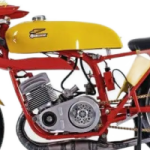
Ray had a Gold Star engine in his shed. He began restoring it to a high standard without any particular goal in mind. Kevin saw the work, asked whether there was a gearbox to match, and when told there could be, replied simply: build the gearbox and I will build you a short circuit frame. Ray spent considerable time studying magazine photographs of English grass trackers, trying to extract every detail of geometry and proportion that might inform the design. Kevin drew a full-size working drawing on a large sheet of plywood, specifying 21-inch front and 18-inch rear wheels, a frame built from Reynolds 531 tubing, assembled using nickel bronze rods. The geometry was aimed as closely as photographs would allow at the Hagon standard. Provision was made from the outset for the frame to accept a wide variety of engines: single and twin-cylinder four-strokes and the emerging unit-construction two-stroke competition units. Kevin also designed and manufactured a quick-action throttle of his own, so effective that examples are still sought after today.
A team of people contributed their skills to completing the prototype. Doug Underwood made the tank pattern, which was pressed and welded. A friend of Ray’s skilled in fibreglass made the moulds and the fibreglass mudguards. Ray himself, a signwriter by trade, designed and painted the KERR tank logo, added the paint finish, and applied the distinctive mudguard striping. Kevin had access to the engineering shop where he worked as leading hand during lunch hours and after hours, allowing him to manufacture many components in-house including wheel hubs, which the team laced themselves. All fixings, bolts and studs were made to measure. Kevin’s wife Barb kept the crew supplied with tea through the many late nights of work.
The finished machine incorporated several features of Kevin’s own devising. The swinging-arm rear suspension could be converted to a rigid rear end by removing five bolts, producing a configuration close to the ESO speedway machine widely regarded as the best in the business. Front fork travel could be reduced to two inches. The forks were sprung by rubber bands, as on the Hagon, but where the Hagon offered a single heavy-duty band, Kevin’s design used several lighter rubbers, allowing fine tuning to suit prevailing conditions. A quickly detachable damper was concealed behind the front number plate, released by a single clip. Varying the oil in the damper altered the damping characteristics, a feature that Bob O’Leary in particular used to great effect: one look at a track and he could set the bike up precisely. The footrests were designed to fold on contact with the ground under extreme lean angles, allowing the machine to be laid over as far as conditions demanded without digging in.
In 1968 the prototype was complete: a new motorcycle fitted with a 500cc Gold Star engine, ready to race. The first test site Kevin chose proved so rough a trials machine would have struggled, but the baptism of fire at Mandurah told them everything they needed to know. The critics were vocal: too light, not strong enough, it would never withstand the rigours of racing. Kevin let the bike answer. Ray found it an absolute missile. On that first day, one of the loudest critics, riding a heavy scrambler aggressively, eventually T-boned the Kerr and ran over the front wheel. It was at that moment that Bob O’Leary, standing in the pits, took one look at the damaged machine and said he wanted one. He became the owner of frame number 0001, fitting it with a unit-construction 500cc Triumph and specifying a 23-inch speedway-style front wheel for better handling and grip. The speedway promoter Con Migro, who had watched O’Leary operate the machine, gave him the name he carried for the rest of his career: the Wizard on Wheels.
In 1969, the National Short Circuit Title was held at Forrestfield. The eastern states riders arrived in force, race-fit from competing three times a week, with purpose-built machines and well-founded confidence. Ray had replaced the 500 Gold Star engine with a 350, a mongrel unit built around a B33 crankcase, an iron B31 cylinder and an early Gold Star head. Mongrel it may have been, but the light weight of the Kerr made it competitive far beyond what its specification suggested. Ray secured the 350cc and 500cc national titles. Bob O’Leary, who as one correspondent noted seemed capable of winning in any class of motorcycle racing, took the unlimited title on the Kerr. On an earlier visit to Adelaide, Ray had not taken silverware but had won the Interstate Riders Invitation and set fastest time of the day. The Kerr’s reputation was now national.
Kevin began producing additional machines. Jigs were made, patterns produced for all the ancillary components, with each different engine and gearbox combination requiring its own plates, footrests and fittings. The machines were sold as rolling chassis at cost, approximately five hundred dollars, requiring only a powerplant to be race-ready. The first batch of ten sold before they were built. An enthusiast in Sydney offered to act as agent, co-ordinating orders and parts, with machines freighted to the east via Ansett at a favourable rate. At least thirty Kerrs found their way into new ownership across Australia.
The toll on Kevin and his team was severe. Working full days and then through the nights, with neighbours increasingly unhappy about the late engineering noise and family life largely suspended, the operation was not sustainable. In 1970, emotionally and physically exhausted, Kevin declared that there would be no more Kerrs.
The work continued briefly in other forms. A speedway sidecar frame was built for Tom McQuade, using the same Reynolds 531 tubing and nickel bronze welding as the solos. Critics predicted the welds would not survive speedway use. A test was devised: three pieces of tube were welded into a Z-shape and subjected to a press. Each weld held while the tube tore. The finished sidecar was light, strong and handled well, but the JAP V-twin engine it relied on failed repeatedly. In one incident, a cylinder failed mid-race while leading, the sudden loss of traction lifted the front wheel, and the now-riderless outfit returned to the track and seriously injured another competitor. The critics returned in full voice. Kevin was deeply hurt, and that ended his involvement with speedway.
A motocross sidecar and a road racing sidecar frame also emerged from the Kerr workshop, the latter written off in a racing accident before it was fully developed. The last project that bore the Kerr name and philosophy was a long-track solo, drawn up from the same combination of magazine photographs and careful measurement, translated onto plywood and then into metal. A stunning machine by all accounts, it was never started. Ray Long’s competitive career had caught up with him, a series of serious injuries ending his riding days and leaving him with lasting pain.
Kevin Kerr went on to open Kerr Engineering in Welshpool, a growing industrial suburb of Perth, starting from one third of a motor trimming premises with machinery bought on a limited budget. The business quickly established a reputation built on the same qualities that had characterised the motorcycle: precision work, total commitment, and a genuine desire to solve problems. That the machines he built in the late nights of 1968 and 1969 won a national title and were still being sought after and raced across Australia is the measure of what was achieved in those evenings in a Perth engineering shop, fuelled by cups of tea and the conviction that a light, well-designed machine would answer all criticism.