K & K/ KÜCHEN | 1924-25 | Germany :
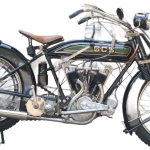
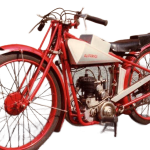
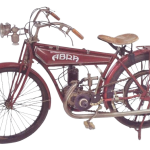
K & K — Lehrte, near Hannover, Germany, 1924–1925 The company K.&K. was produced by Kuhlmann & Könecke, Blech und Eisenwerk, of Lehrte, near Hannover. The company name — Blech und Eisenwerk, meaning sheet metal and ironworks — reveals its industrial origins clearly. This was not a dedicated motorcycle manufacturer but a metalworking and fabrication firm that, like dozens of German industrial companies in the mid-1920s, turned a portion of its production capacity towards the motorcycle market.
The firm’s core competence in metalwork gave it the pressing and fabrication skills needed to produce frames and bodywork, while the engine — the technically ambitious Küchen unit — was sourced externally. Lehrte is a small town east of Hannover in Lower Saxony, situated at an important railway junction where the Hannover–Berlin mainline and several branch lines converge. Its industrial character in the 1920s was shaped by railway engineering, coal extraction from the nearby Ronnenberg coalfield, and the network of metalworking firms that had grown up around these activities. Kuhlmann & Könecke occupied this industrial milieu, and their decision to build motorcycles in 1924 was consistent with the behaviour of many similar firms across Weimar Germany at the moment when the economy began to stabilise after the catastrophic hyperinflation of 1923.
The defining technical feature of the K & K motorcycle was its engine. The Küchen three-valve overhead camshaft unit was among the most sophisticated proprietary motorcycle engines available in Germany in 1924, and its selection by Kuhlmann & Könecke indicates genuine ambition rather than a simple assembler’s exercise. Richard Küchen was born on 15 March 1898 in Bielefeld, the son of a steam machine manufacturer. He trained as a mechanic and, after the First World War, formed and ran a farm equipment business while also working on his own constructed motorcycle engines. These proved popular and he began to add a supply business to his workload. In 1924, he moved to Heilbronn and Lahr, and later worked for Zündapp and Victoria, establishing himself as a talented engine designer. At one point Küchen was responsible for half of all German proprietary engines. In three decades of unremitting work he produced everything from 50cc tiddlers to the mighty Zündapp two-wheel-drive combinations used so effectively by the German army in the Second World War. Sidevalves, OHV, OHC; singles, twins, fours; two-strokes, four-strokes: Küchen did the lot.
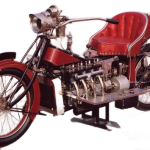
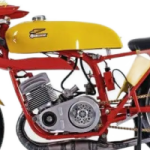
The engines fitted to the K & K machines were the three-valve OHC units in 198cc and 498cc capacities. The three-valve configuration — two inlet and one exhaust, or more typically one inlet and two exhaust — was itself an unusual technical choice in 1924, reflecting Küchen’s awareness of contemporary racing engine practice. Küchen in Germany, along with Chater-Lea in Britain and Capriolo in Italy, made face-cam engines of this type. In the face-cam system, a circular disc with profiled ramps machined into its face rotates at the top of a bevel-driven vertical shaft, bearing against the valve stems or rockers directly. The result is an exceptionally clean and compact valve-gear arrangement with short, stiff mechanical paths between cam and valve, favourable for high-rpm operation and precise timing — advantages that were well understood by German engineers who had closely followed the OHC developments of Italian and British racing machines.
Küchen engines powered machines for Aeros, Ardie, Atlantis, Carnielli, Meyra, Tornax, Vittoria, WMR and many other motorcycle manufacturers. Models included 348cc and 498cc three-valve OHC engines made during the mid to late 1920s. The K & K’s 198cc unit was among the smaller Küchen offerings, aimed at the lightweight class that dominated the German market in the immediate post-stabilisation period, while the 498cc machine placed the marque in direct competition with the more established names for which Küchen engines were simultaneously being supplied.
The K & K arrived at a precise historical junction. By 1924 the German currency had stabilised and reparations payments resumed under the Dawes Plan, ending the worst of the hyperinflation that had made economic planning impossible. A new currency, the Rentenmark, backed by the US gold reserve, had been introduced in August 1924 and realistic reparation payments had been agreed. For industrial firms, currency stabilisation meant that investment could be planned, components could be priced and contracts honoured — the basic preconditions for any manufacturing venture. The result was an extraordinary proliferation of motorcycle manufacturers across Germany in 1924–1926.
The German K-marques page alone lists, for this period, KADI, Katho, Kessel, KM, KMB, K.R., K.Z., and numerous others — almost all of them tiny operations that existed for two or three years before succumbing to the competitive pressures that followed stabilisation. The lightweight motorcycle was the product of the moment: inexpensive to manufacture, affordable to the newly solvent German consumer, and technically accessible enough that a metalworking firm with no prior motorcycle experience could credibly enter the market if it could source a reputable engine. Several other firms in the same period chose the Küchen engine for exactly the same reasons. The Berlin firm Indus built motorcycles in 1924 and 1925 using OHC Küchen 497cc engines, with chain drive via a Sturmey-Archer gearbox, and did well in competition. Rupp produced a 498cc model with a very modern Kürchen engine with 3-valve OHC valve train, available in Sport and Supersport versions with single and dual exhaust ports.
The K & K’s engine specification placed it in sophisticated company — the Küchen was not a budget unit but a performance-oriented proprietary engine chosen by builders who wanted their machines to be taken seriously. Short production and closure K & K produced motorcycles for only two years, 1924 and 1925, before ceasing production. The reasons are not documented in surviving sources, but the broader pattern is clear. The mid-1920s German motorcycle market was brutally competitive: established manufacturers with years of production experience, larger capital bases, and established dealer networks competed directly with dozens of small new entrants like K & K. The post-stabilisation economy, while an improvement on hyperinflation, was not a period of sustained German prosperity — unemployment remained high, purchasing power was constrained, and credit was expensive. Firms that had entered the market hoping to benefit from pent-up demand often found that the market could not sustain so many competitors simultaneously.
Kuhlmann & Könecke’s industrial background as a metalworking firm meant that cessation of motorcycle production did not necessarily mean the end of the company — it most likely meant a return to the sheet metal and ironwork that was its core business. The motorcycles were a two-year venture in a market that proved too crowded and too short-lived to sustain a new entrant, however well-chosen its engine. Legacy The K & K occupies a characteristic position in German motorcycle history: a technically serious but commercially brief venture by an industrial firm exploiting a short window of market opportunity. Its choice of the Küchen three-valve OHC engine in two capacities — covering both the lightweight class and the half-litre performance segment — suggests a builder with genuine ambition and some understanding of where the market was heading. That the Küchen engine went on to power celebrated machines from Ardie, Tornax and others into the late 1920s and beyond, and that Küchen designs included the 1933 Zündapp flat-four and the 1940 Zündapp KS750, confirms that K & K’s engine selection was astute. The commercial failure was the product of circumstance and competition, not of the machines themselves.