KC (KIRCHHEIM) | 1921-24 | GERMANY :
The KC motorcycle, sold under the initials of its founding company Kirchheim & Co., was a Magdeburg enterprise that traced a trajectory familiar to dozens of small German manufacturers of the early 1920s: founded in ambition, expanded on the back of volatile conditions, brought to the market in force, and finished by the very economic forces that had briefly seemed to make small-scale manufacture possible.
The firm was manufactured by Kirchheim & Co. of Magdeburg, founded by Karl Kirchheim in 1920 or 1921 in partnership with Ferdinand Schlegel. From 1921 the address was Nachtweide 89 in Magdeburg-Neustadt, moving from 1923 to Walmbergsweg 21 in Magdeburg-Sudenburg, and from 1926 to Alt Fermersleben.
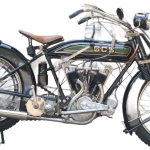
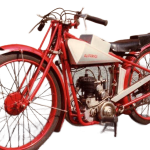
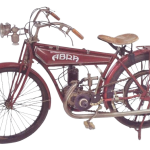
The firm built a variety of models, among them 100cc two-stroke powered bicycles, 250cc longitudinal HO twins, and according to at least one source, a scooter. For 1923 they advertised a 3 PS Motorräder, a 1.4 PS Leichtkraftrad, and a 1.4 PS Hilfsmotor. The range therefore spanned from a simple auxiliary bicycle engine at the lightest end of the market to a heavier twin-cylinder machine, covering the spectrum that many assemblers of the period aimed at: something for every price point in an economy where purchasers were making whatever savings they could.
The company made a significant move in 1923. The company went public in 1923, but with the country ravaged by hyperinflation, the IPO failed in 1924. The decision to attempt a public offering was a measure of how seriously the founders took their expansion plans. The timing proved catastrophic. The most dramatic stage of German inflation was reached between January and November 1923, fuelled by the French occupation of the Ruhr Valley and the German government’s decision to support a general strike by printing ever more Reichsmark. By late 1923, Germany’s real income was barely half that of 1913. Unemployment among the unionised workforce rose from 4 percent in July 1923 to 23 percent in October. An IPO launched into that environment stood no chance. Capital that had been raised or promised dissolved in value before it could be deployed, and the corporate structure that might have given the KC a future evaporated with it.
The address changes that the records show, from Neustadt in 1921 to Sudenburg in 1923 and Alt Fermersleben thereafter, suggest a firm that kept attempting to maintain some activity even after the formal collapse of the public company, but the motorcycle manufacturing chapter was over by 1924. Magdeburg itself had other motorcycle connections in the same period, most notably the Grade Motoren-Werke, which Hans Grade had founded in the city in 1905 and which used the same two-stroke lightweight formula, and the Deloma of 1924, which attempted crude-oil engines in similar circumstances. The KC belonged firmly to that Magdeburg tradition of small-scale engineering enterprise, building accessible motorised transport from a city with real industrial capability but without the scale to survive the particular storm of the early 1920s.