KAWASAKI | 1949- | Japan :
Kawasaki Heavy Industries was founded by Shōzō Kawasaki on 15 October 1896. The company built ships, then aircraft, before turning to motorcycle engines. In 1918 Kawasaki turned towards aircraft, building the first metal aircraft in Japan. In 1949 they turned their attention towards the manufacture of motorcycle engines.
Kawasaki’s first motorcycle, the Meihatsu, was produced in 1954, powered by the company’s own KB-5 engine. An improved model, the Meihatsu 125 Deluxe, was introduced in 1956, the year in which the Kawasaki logo was first stamped into the engine side cover.
The domestic sales company Meihatsu Kogyo was founded in Japan alongside this activity. A business alliance with Meguro Manufacturing Company followed. Meguro was Japan’s oldest motorcycle manufacturer, dating back to 1937. Kawasaki acquired the Meguro company in 1961. The B8 was the first motorcycle to be built completely from Kawasaki components. It was based on the Meihatsu B7 and was a 125cc air-cooled two-stroke with a four-speed gearbox, produced from 1962 through 1965. In 1963 the Kawasaki B8 took first through sixth places in the 125cc class motocross race at Aonogahara, Japan.
The motorcycle SG and SGT were released under the Kawasaki Meguro brand, followed by the announcement of the W1. In 1960 Kawasaki built their own motorcycle manufacturing plant, and in 1966 they released the 650cc W1, their most notable effort to that point. They then produced lighter bikes: the 250cc A1 Samurai and the 350cc A7 Avenger, which had their fair share of success.
The Kawasaki H1 Mach III was a 500cc two-stroke three-cylinder sport bike produced from 1969 through 1975. By the mid-1960s the US had become the largest motorcycle market, and the H1 was developed to target it. Because of its success Kawasaki released two smaller derived models, the 250cc S1 and 350cc S2. For those wanting more power, a 748cc version, the H2 Mach IV, followed in 1972.
The Kawasaki Z1, also known as the 900 Super Four, entered production in 1972 and was sold as a 1973 model. Its engine was a DOHC 903cc air-cooled inline four with an exactly square 66mm bore and stroke, producing 82 PS at 8,500 rpm, with a five-speed gearbox and a top speed of 130 to 132 mph. Approximately 85,000 units were produced through 1975. When first unveiled at the Cologne Motor Show in 1972 the Z1 set the motorcycling world aflame. After its release in 1973 it won the Motorcycle News Machine of the Year award for four consecutive years. With a top speed of more than 130 mph it was the fastest production motorcycle of its day. Ben Inamura, an engineer Kawasaki inherited with its acquisition of Meguro, was responsible for the Z1’s engine development. Honda’s introduction of the CB750 had made it clear that Kawasaki’s new four-cylinder engine would have to exceed 750cc, resulting in the 903cc displacement. The Z1 project was codenamed New York Steak.
The Kawasaki GPZ900R, produced from 1984 to 2003, was the earliest member of the Ninja family of sport bikes. Also known as the Ninja 900, it was powered by a 908cc liquid-cooled DOHC four-cylinder engine with four valves per cylinder, producing 115 bhp at 9,500 rpm and achieving a top speed of 151 mph.
The ZX-10 Tomcat of 1988 was a 997cc liquid-cooled inline four producing 135 hp at 10,000 rpm and capable of 167 mph, making it the fastest production motorcycle of its day. It used an aluminium perimeter frame and was produced through 1990.
The ZZ-R1100, also known as the ZX-11, succeeded the ZX-10 in 1990 and was produced through 2001. Its 1,052cc liquid-cooled DOHC inline four produced 145 bhp at 10,500 rpm with a top speed of 283 km/h, making it the fastest production motorcycle in the world for much of the 1990s.
The ZX-7R, produced from 1989 to 2003, was developed in response to the growing superbike racing market following the introduction of the Superbike World Championship in 1988. It used a 748cc liquid-cooled 16-valve DOHC inline four in an aluminium twin-spar frame. A homologation variant, the ZX-7RR, offered variable rake and an adjustable swingarm pivot.
The Ninja ZX-9R, produced from 1994 to 2003, was a 899cc liquid-cooled inline four sport bike. The 1998 model brought a heavily redesigned engine and chassis, with magnesium engine covers, titanium muffler, and Kawasaki Throttle Responsive Ignition Control.
The ZX-12R was introduced in 2000 as the new flagship of Kawasaki’s supersport Ninja series, featuring the first mass-produced aluminium monocoque frame.
The Ninja ZX-10R entered production in 2004 as the successor to the ZX-9R, powered by a 998cc liquid-cooled 16-valve DOHC inline four. It has been continuously updated and revised throughout the years and remains in production as of 2026. In 2024, Kawasaki produced a 40th Anniversary Edition of the ZX-10R to mark four decades since the Ninja name was first introduced in 1984.
The Z1000 streetfighter was introduced in 2003 as a naked machine based on the ZX-9R engine, using a backbone frame with the engine as a stressed member. It was redesigned in 2010.
The Ninja ZX-14, also sold as the ZZR1400, entered production in 2006 as a 1,352cc sport-touring machine, enlarged to 1,441cc in 2012, with a claimed top speed of 186 mph.
The Versys adventure-touring range was introduced in 2006 and has expanded to include the Versys 650 and the Versys-X 300, with both models continuing in the 2026 model year lineup.
The Ninja 400 was introduced in 2018 as a successor to the Ninja 300, powered by a 399cc liquid-cooled 8-valve DOHC parallel twin producing around 45 hp, assembled in Thailand and Brazil.
The Ninja H2 and track-only H2R entered production in 2015. Both are powered by a supercharged 998cc DOHC inline four. The street-legal H2 produces 200 hp claimed at 11,000 rpm with a top speed of 296 km/h, while the track-only H2R produces 326 hp at 14,000 rpm with a top speed of 330 km/h. Parts of the H2R’s bodywork, including carbon-fibre winglets, were designed with assistance from the Kawasaki Aerospace Company, and the supercharger was developed in collaboration with Kawasaki’s Gas Turbine and Machinery Company and Corporate Technology Company, making the H2 the most comprehensive expression of Kawasaki Heavy Industries’ multi-division engineering capability.
In 2024, Kawasaki launched its first all-electric motorcycles, the Ninja e-1 and Z e-1. Both are powered by a brushless electric motor producing 9 kW peak power and feature dual removable lithium-ion battery packs. Performance is comparable to the 125cc class, with an e-boost function providing short-duration acceleration equivalent to a 400cc machine. The Ninja e-1 carries sport fairing in the Ninja tradition while the Z e-1 is naked. Kawasaki has also indicated that a hydrogen-powered model is in development, with the e-1 naming scheme suggesting more powerful variants are planned.
The 2026 Ninja ZX-10R is powered by a 998cc liquid-cooled inline four producing 196 hp at 11,500 rpm and 114 Nm of torque at 11,300 rpm, with the 2026 model year receiving an additional oxygen sensor for cleaner emissions compliance.
Sporting History
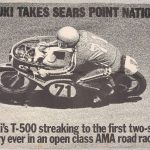
The H2R of 1971, a 748cc two-stroke three-cylinder production racer, inspired such awe in racing rivals that it was nicknamed the Green Meanie. In the 1973 AMA Road Racing Championship, Gary Nixon rode a Kawasaki to three race victories to take the title.
The KR250 and KR350 were created in 1974 to compete in the World Grand Prix, the pinnacle of motorcycle road racing. In the capable hands of Kork Ballington and Anton Mang, the KRs virtually dominated the 250cc and 350cc classes from 1978 to 1982. The KR250 and KR350 employed a radical tandem-twin two-stroke layout, using two inline cylinders with separate geared-together crankshafts to avoid the excess width of a conventional parallel twin, while retaining the rotary inlet valves that had been a feature of previous Kawasaki two-strokes. The South African Kork Ballington secured both the 250cc and 350cc World Championships in 1978 and 1979, while German Anton Mang took the 250cc World Championship in 1980 and 1981 and the 350cc title in 1981 and 1982. In the two classes Kawasaki riders took eight world championships, and in the GP250 class Kawasaki was manufacturers’ champion four consecutive years.
In the United States, Eddie Lawson won numerous AMA Lightweight class races, culminating in two AMA Lightweight National Championships on the KR250 in 1980 and 1981.
The Kawasaki factory team hired Rob Muzzy as engine builder and eventually the entire bike’s constructor. Eddie Lawson won the AMA Superbike Championship in 1981 and 1982, and Wayne Rainey took the title in 1983, giving Kawasaki three consecutive American superbike crowns.
From 1981 to 1983 the Endurance World Championship was dominated by Kawasaki’s KR1000 endurance racer. The French endurance team Kawasaki France Performance earned Kawasaki the manufacturers’ title for three consecutive years. In 1981 and 1982 Kawasaki riders took all the top positions, and 1983 was the year of the famous Kawasaki podium sweep at the Le Mans 24 Hours.
After ceasing works participation in 1983, Kawasaki returned to the Endurance World Championship in 1988 with the ZXR-7 TT-F1 race machine, and dominated the field for three consecutive years capturing the title in 1991, 1992 and 1993. At the 1993 Suzuka 8 Hours, the pairing of Scott Russell and Aaron Slight were victorious, earning Kawasaki their first win in the prestigious race.
In 1992 Scott Russell gave Kawasaki its first Daytona 200 win and won the AMA Superbike Championship. The following year, armed with an even more potent ZXR750R, Russell took the World Superbike title in his first year competing in the championship, giving Kawasaki their first World Superbike crown.
In 2002 Kawasaki returned to the World Grand Prix after a 20-year absence, competing in the MotoGP class with the Ninja ZX-RR. At the 2004 Japan GP, Shinya Nakano rode to a third-place podium finish. Development progressed with second-place finishes in the 2005 Chinese GP, the 2006 Dutch GP, and the 2007 Japanese GP.
When Tom Sykes narrowly missed the World Superbike title in 2012 on his Ninja ZX-10R, it set up anticipation across the Kawasaki world. He delivered in 2013, taking nine race victories in 18 podium finishes to win the championship, Kawasaki’s first Superbike World Championship title in 20 years.
In 2015 the Kawasaki Racing Team took the World Superbike series championship with Jonathan Rea, who joined the team that year and rode the Ninja ZX-10R to 14 race victories. Rea went on to secure six consecutive World Superbike riders’ titles from 2015 to 2020, all aboard Kawasaki machinery, establishing an unparalleled streak of dominance in the superbike class. Kawasaki accumulated eight World Superbike manufacturers’ titles, largely driven by Rea’s record-breaking run.
The 2019 Suzuka 8 Hours saw the Kawasaki Racing Team take victory for the first time since 1993, while Team SRC Kawasaki France took the 2018-2019 Endurance World Championship title.