KD | 1905-09 | France :
Albert Keller-Dorian was born in Mulhouse in 1846 and died in Paris in 1924, a man described as having an extraordinarily fertile brain. He trained as a printmaker in Manchester, England, and in 1880 assumed control of his father’s business in Mulhouse, building printing machines. He established branches in Lyon, Germany and Italy.
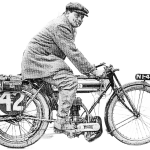
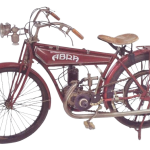
A sideline of Keller-Dorian’s fertile mind was his interest in combustion engines. In 1905 he patented a light four-stroke engine that was extremely simple yet very innovative. The engine could be bought as a set complete with tank, oil pump and various controls to be fitted to an ordinary bicycle. In 1907 another version was marketed as the Auto-Bicyclette, available as a complete motorcycle.
Manufactured by Keller-Dorian of Lyon from 1905, the motorcycles had AIV engines of 170cc and 216cc and were also available in an open frame version. The Swiss patent for the engine was dated 25 October 1906, and a French carburettor patent was dated 21 August 1906. The AIV, or Automatically-operated Inlet Valve, arrangement was the principal engineering novelty of the design: a single valve seat in the centre of the cylinder head carried an automatically-operated inlet valve surrounded concentrically by the mechanically-operated exhaust valve, with a perforated casing around the valve seating forming the silencer and an additional exhaust port at the bottom of the cylinder. The two engine sizes used bore and stroke dimensions of 60x60mm for the smaller unit and 65x65mm for the larger. The carburettor used no float chamber, regulating petrol flow rather than air quantity. The machines were also available in an open frame version.
The British version of the KD was assembled and marketed between late 1907 and 1909 by Leo Ripault and Co. of Poland Street, Oxford Street, London, under the same KD designation. The British machine differed from the French original in being fitted with a spring fork that preceded the Earles pattern by several decades.
Keller-Dorian’s principal business was cylinder engraving for the paper and textile industries. After the First World War, he joined forces with inventor Rodolphe Berthon, who had developed a lenticular colour film process, and began work on the embossing machinery needed to produce lenticular film at scale. The additive colour cinema process, known as Keller-Dorian-Berthon, was patented in 1914. In 1923 the first public screening of a short colour film entitled Colomba took place at Mulhouse. The Keller-Dorian company was subsequently bought by an Anglo-American group in 1930, and the patents were used by Technicolor, Kodak and Paramount. The lenticular colour cinematography process, which used microscopic lens elements to separate red, green and blue light onto a single frame of black-and-white film, remains part of the historical lexicon of cinema technology.