KOVROV | 1946-2003 | Russia (USSR) :
The Kovrov motorcycle story begins not in a factory built for two-wheelers, but in one of the most important weapons plants in Russian history. The Degtyaryov Plant, known by its abbreviation ZiD, was founded in Kovrov in 1916 as a firearms factory and has been supplying Russian and Soviet armed forces with weapons ever since. Weapons such as the Degtyarev anti-tank rifle, the Degtyarev infantry machine gun, the Shpagin submachine gun, and the Goryunov heavy machine gun were all manufactured at the plant. It was an institution defined entirely by the science of war, and that it would become one of the Soviet Union’s most prolific motorcycle manufacturers is one of the more unexpected industrial pivots of the twentieth century.
The transition came directly out of the rubble of the Second World War. After victory in the Great Patriotic War, the Soviet leadership decided to establish the production of light and medium-sized motorcycles on the basis of technologies and equipment of the German firm DKW, which had fallen within the Soviet occupation zone. The Soviet Union took plans, tooling and even several dozen personnel as war reparations to a factory in Kovrov, and produced copies of the RT125 as the K-125. The design they had acquired was no ordinary machine. The DKW RT, which stood for Reichstyp or National Model, had the distinction of being the most copied motorcycle in the world. The power unit, a simple single-cylinder two-stroke, was the most advanced and efficient design at the time. The Soviets were in distinguished company in choosing to replicate it. It was reproduced in countries including Russia, several Eastern European communist nations, India, the USA and Japan.
The order to commence motorcycle production at the Kovrov plant was issued in March 1946, and as soon as November the first series of 59 K-125 units were assembled. The K-125 was equipped with a two-stroke single-cylinder engine with a working volume of 123.7cc and a power output of 4.25 horsepower. The engine was located in the same block as a three-speed gearbox, the rear wheel had no shock absorbers and was attached directly to the tubular welded frame, and the front fork was of parallelogram design with stamped blades. The K-125 could reach 70 kilometres per hour. It was modest by any measure, but its price made it the most affordable and mass-produced two-wheeled vehicle of the post-war period in the Soviet Union.
The factory wasted no time in developing the design forward. The K-125M, produced from 1951 to 1955, replaced the parallelogram front fork with a telescopic fork with hydraulic shock absorbers, while otherwise keeping the design largely unchanged. Then came the K-55 from 1955, bringing a moderately boosted engine, followed by the K-58 from 1957, which differed from its predecessor in its increased fuel tank capacity and a more powerful 5 horsepower engine, along with a battery-free ignition system and a speedometer mounted in the headlight, giving a top speed of 75 kilometres per hour.
The most significant development in the Kovrov series came with the K-175. The Kovrovets K-175 was a Soviet road motorcycle equipped with a short-stroke single-cylinder two-stroke engine of 173.7cc. It had a cowled rear end and a carburetor covered with a casing, 16-inch wheels, a fully enclosed chain, and a two-seater saddle. The K-175 became the base for all Kovrov motorcycles that were mass-produced until 2003, including the entire Kovrovets and Voskhod families. The 175cc engine was an original design solution and, according to Soviet industry observers at the time, represented something of a revolution in domestic motorcycle thinking. Only one plant in the country decided to take such a step, and seventeen engineers and workers directly involved in the development were awarded silver and bronze medals by the VDNKh exhibition committee, with the plant itself receiving a second degree diploma and a small silver medal.
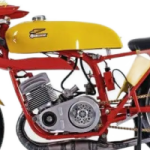
Throughout the Kovrovets years, the factory also produced limited numbers of purpose-built competition machines alongside the civilian models. Limited production competition models included the K-55C1, K-58SK, K-58CM, K-175SK, K-175CM, and K-175SMU. The racing version of the Voskhod road bikes used an engine that was an evolution of the original DKW RT125, enlarged to 175cc. The first production competition version was introduced in 1964, featuring a cast-iron cylinder, and from 1967 onward the Kovrovets racers received an improved alloy cylinder capable of producing 17 to 20 horsepower in factory trim. These machines competed at serious levels, and in June 1964, Kovrov riders as part of the USSR national team participated in the FIM motor rally held in Geneva, Switzerland, where the USSR national team took first place overall.
By 1971, Alfeev Valerie and Kuzoukin Alexander were participating in World Sidecar Championship races on a Kovrovets. Later, the racing programme extended into circuit competition, where the Voskhod-175 ShK became the first mass-produced racing motorcycle from the Degtyarev plant since the K-125S and K-55S2 models of the 1950s, and provided the backbone of the 175B class of sports motorcycles for many years. Among the most celebrated competitors of the era was the Estonian rider Luule Tull, who between 1966 and 1991 won 21 gold, 7 silver and 3 bronze medals in circuit and hippodrome racing competitions, earning 42 Estonian Champion titles on Voskhod machinery.
The name changed to Voskhod, meaning Sunrise, in around 1966. The transition was one of branding rather than reinvention. The engineering lineage that had begun with a German wartime design, absorbed into a Russian weapons factory in the chaos of 1946, continued its evolution for decades more, eventually remaining in production in various Voskhod forms until as late as 2003. Few motorcycles anywhere in the world can trace a continuous thread from a single borrowed design through more than half a century of uninterrupted production, and the Kovrov story is all the more remarkable for the unlikely institution that carried it.