KOSTER (KS) | 1923-25 | Germany :
The Koster motorcycle, also sold under the initials KS, was a small German lightweight machine produced between 1923 and 1925, a period that placed it squarely in one of the most turbulent and paradoxically creative moments in the history of German industry. Hundreds of small factories across Germany began making motorcycles at this time, in direct response to the pressing need for light, inexpensive transportation that had emerged after the First World War. Because of the sheer number of competing brands, most were forced to find customers within their own region, since building a large dealer network was simply impossible at that scale. Koster was one of these small regional builders, and like many of its contemporaries, it sourced its power units from the specialist engine makers of the day rather than developing its own.
The timing of Koster’s existence was remarkable. The hyperinflation of 1923 was triggered by the French-Belgian military occupation of the Ruhr valley in January of that year. The German government urged workers and employers to close down the factories, and idle workers were paid during the following months with a currency inflating so rapidly that printers gave up trying to print numbers on bills. By mid-1923 the German mark was losing value by the minute. That any manufacturer could found and sustain production through such conditions speaks to the desperation for affordable transport and the stubbornness of small entrepreneurial enterprise in the face of economic chaos.
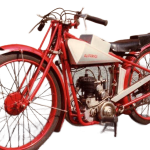
The Koster machines were built on pressed metal and tubular frames, a construction approach common to the lightweight category of the era. The disc wheels and fully enclosed chain and belt drive gave the machines a clean, integrated appearance, and the fuel tank was built integrally into the upper frame, a design choice that reduced weight and improved the tidiness of the overall package.
For their engines, Koster turned to two of the most technically interesting suppliers active in Germany at that moment. The 123cc Bekamo unit was anything but ordinary. Hugo Ruppe, who had previously created the first DKW two-stroke engines, founded the Bekamo factory in Berlin, and the engines he produced there were the first two-stroke units developed with a crankcase auxiliary pump. The Bekamo piston-port single used a dummy piston and cylinder placed opposite the functional piston at the base of the crankcase. It appeared to be an asymmetrical flat twin at first glance, but the supercharging cylinder, dubbed the Ladepumpe or charging pump, had no porting or spark plug. This arrangement forced additional fuel-air mixture into the combustion chamber, giving the tiny engine a meaningfully stronger power output than a conventional two-stroke of the same displacement could produce. Bekamo engines were used in many machines of the period and were built under licence by Windhoff, MFZ, and Eichler. They were, in short, among the most sought-after small powerplants available to any assembler of the day.
The 144cc Cockerell engine fitted to other Koster models came from the workshop of Fritz Cockerell, whose real name was Friedrich Gockerell. Fritz Cockerell was a German pioneer of motorcycle, automotive and engine construction who had worked as a machinist in an airship factory, then in steam turbine construction at Maffei, before moving to Rapp Motorenwerke, which later became BMW, where he worked as a test engineer. He was also the engineering mind behind the extraordinary Megola, a motorcycle with a five-cylinder radial engine mounted inside the front wheel, and his small two-stroke engines for lightweight motorcycles and auxiliary bicycle drives were manufactured in a Schwabing workshop, covering displacements of 110cc to 170cc, some of which were water-cooled. His machines won the 150cc class German Championship in 1924.
That Koster fitted its machines with engines from both Bekamo and Cockerell placed it at the intersection of the best lightweight two-stroke technology available in Germany at the time. Neither supplier was simply a parts-bin choice. Both represented genuine engineering ambition, and the variety of engine options suggests that Koster was attempting to offer different specifications to suit different buyers in what was an intensely competitive market.
Ruppe’s Bekamo venture, despite producing an engine that was an instant hit, ended in bankruptcy by 1925. Cockerell too found that competition was too strong, both from the large manufacturers and from the many small workshops producing similar machines. Koster itself did not survive beyond 1925 either, and the reasons are not difficult to identify. The stabilisation of the German currency in late 1923 and early 1924, while welcome in broad terms, removed the very conditions of extreme demand for cheap transport that had sustained so many small assemblers. As the economy slowly regularised and larger manufacturers consolidated their positions with better distribution and more competitive pricing, the small regional builders that had populated the early 1920s found their footing disappearing beneath them. Koster, like dozens of its contemporaries, quietly ceased production, leaving behind machines that were technically well-specified for their time and historically representative of one of the most concentrated bursts of two-wheeled entrepreneurialism that Germany ever produced.