KOLIBRI | 1923-30 | Germany :
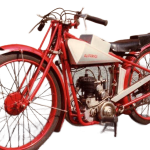
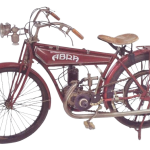
Kolibri, meaning “hummingbird” in German, was a fitting name for a product designed around smallness, lightness, and ease of use. Cycle attachment engines were available separately or assembled with a Kolibri bicycle, marketed by the Europa firm in Munich, who fitted them to Dixi cycles. The Kolibri engine may later have been renamed Markus. A second variant came from a different Munich address: a 110cc two-stroke auxiliary bicycle engine mounted above the front wheel, available as a complete machine or as a kit, produced by Weka G.m.b.H. of Munich. The name itself was used by more than one firm, with a number of companies employing variations of the Kolibri name.
The Kolibri arrived at the precise moment when Germany was in the forefront of cyclemotor design and manufacture, with early motorcycle development involving bicycles being fitted with auxiliary engines which, as cubic capacity increased in subsequent models, became fully-fledged motorcycles. Yet the commercial reality of the early 1920s German market was a challenging one for the cyclemotor concept. A few manufacturers produced cycle-attachment engines in the early 1920s, but they were quite expensive to make, and ordinary lightweight motorcycles were cheap enough for the public to buy, so buyers did not necessarily need to purchase one of these “help-engines.”
This tension between the cyclemotor’s mechanical appeal and its awkward market position defined the Kolibri’s seven-year life. Hundreds of small factories in Germany began making motorcycles in this period, responding to the need for light, inexpensive transportation that had arisen after World War I, and because of the large number of competing brands, many were forced to find customers within their own region, as a large dealer network could not be built up. The Kolibri’s dual-channel sales strategy — selling engines separately to buyers who already owned a bicycle, as well as offering complete machines ready to ride — was a sensible attempt to widen its appeal beyond either the full motorcycle buyer or the pure pedal cyclist, and it placed the marque squarely within the broader German tradition of the Hilfsmotor, or help-engine, as an affordable and practical solution for everyday personal transport.