KOHOUT | 1904-06 | Czech :
Petr Kohout (born 1867) attended the Prague Realschule and worked as a practical machinist. A skilled cyclist himself, he moved from Prague to Brno where he established himself in the two-wheeled trade. He registered a workshop for bicycle repairs on Jesuitská Street No. 6, selling English, American, German, and Austrian bicycles. In 1898, he and a partner named Suchánek began manufacturing bicycles under the Bruna trademark. A year later he registered the Kohout company at the same address. He was among the very first in Bohemia to represent two-wheeled motorised machines, selling the obscure Phébus Aster and later Sarolea and Werner motorcycles, and offered the fitment of 1.5 hp internal combustion engines onto ordinary bicycles.
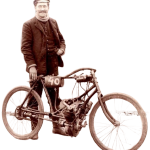
In 1905, Kohout renamed the enterprise Petr Kohout & spol., First Moravian Two-Wheel Motorcycle Factory — a name that loudly announced the firm’s regional pioneering status. In 1906 it was renamed again to Petr Kohout & spol., Motor Vehicle Factory, reflecting a broadened ambition. He probably manufactured motorcycles from 1904 to 1907, and they were exhibited at the Prague Car Salon in 1905.
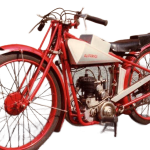
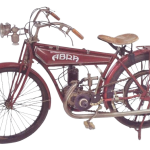
The motorcycles used single-cylinder Minerva and Fafnir engines of 2.5 hp and 2.75 hp, two of the most reputable proprietary power units of the era. Minerva was a Belgian firm founded in Antwerp by Sylvain de Jong. By the end of the 19th century he was producing motorcycles and exporting engines to the UK to power the very first Triumphs, among others, and during this period Minerva became one of the world’s premier names in motorcycles and motorcycle engines. By 1904, Minerva engines featured mechanically opened valves and Longuemare carburettors, available in capacities of 254cc, 345cc, and 433cc. Fafnir was a German manufacturer based in Aachen. From 1900 the company produced motorcycle engines in various capacities, and from 1903 until 1914 they also produced complete motorcycles. Their 2.5 hp single was particularly well regarded for its lightweight construction and phosphor-bronze bearings.
Beyond motorcycles, Kohout also ventured into car production, a bold move for a Moravian workshop of the period. Automobiles were built with engines of up to 8 hp, placing the firm in the same early-adopter category as contemporaries like Laurin & Klement in Mladá Boleslav.
The Kohout name had a lasting impact on the region’s nascent motor industry. Hynek Pavlicek of Tischnowitz (1909–1913) used Kohout engines to build motorcycles with a notably long wheelbase, requiring very long handlebars as the saddle was positioned well to the rear. This shows that Kohout had developed or sourced engines sufficiently capable and available to supply at least one other regional manufacturer, a mark of genuine industrial standing.
The Museum of Technology in Brno holds the oldest known Kohout bicycle in existence, cementing the family’s foundational role in Moravian cycling and motoring history.