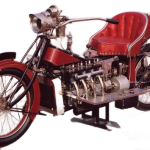
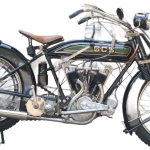
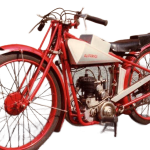
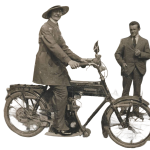
KOEHLER-ESCOFFIER | 1912-57 | France :
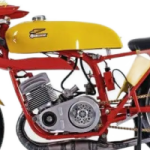
The French Koehler-Escoffier marque was founded in Lyons in November 1912 by partners Marcel Koehler, an engineer, and Jules Escoffier, who had previously been employed at Magnat-Debon as a works rider and mechanic. These ambitious young Frenchmen were concerned primarily with speed. Escoffier was still legally a minor when they founded the company and required a letter of emancipation from his family to sign official company documents. Along with winning numerous races in the early years, the company developed its famous 500cc overhead-valve V-twin Mandoline engine, named for the shape of its timing cover and cam drive. The Mandoline won the Argenteuil hillclimb and a gold medal in the Paris-Nice rally, making the marque one of the most famous in France.
Escoffier died in 1914. Production was suspended during the war years. At the war’s end Koehler sold the firm, and in 1922 it was acquired by Raymond Guiguet, an engineer and accomplished rider. Guiguet took the original Mandoline V-twin, improved it with a three-speed gearbox, hemispherical cylinder heads and revised valves, and raced it to reveal its potential. His ambitions then pushed him toward something more advanced. When the Mandoline 500cc single could be developed no further, Guiguet began designing its replacement. His company’s feeble finances compelled him to economise on foundry patterns: the cylinder castings were designed to serve both a 500cc OHC single and a 1,000cc OHC V-twin derivative. The V-twin used as many components of the 500 as possible, with shaft-and-bevel-driven overhead camshaft and twin-port heads. The rear cylinder was simply turned back-to-front to give the tailpipes a straight run. Only thirteen of the 1,000cc V-twins were built between 1927 and 1935. The first version of the K-E OHC V-twin appeared in 1927 and developed 35hp at 5,500rpm, with such a power-to-weight ratio that the rear tyre had to be glued onto the rim with lacquer to prevent it from spinning at startup.
The first 1,000cc V-twin was entrusted to Edouard Grammont, who raced under the name Eddoura, and who had previously achieved outstanding times hillclimbing highly tuned Mandolines. The 1,000’s first outing was a disaster, but at the second attempt Eddoura won the Planfoy hillclimb, and at Laffrey beat the works rider Rolland on a 500 Terrot by over 22 seconds. Despite these results Guiguet was, by reputation, a fantastic engineer and a great racer but a terrible businessman, and Koehler-Escoffier was, once again, on the brink of bankruptcy.
The rescue came from a regulation change in the French National Championship, whose governing body ruled that only machines built completely of French components could compete. This threw rival maker Monet-Goyon into a panic, as their works team had depended on Swiss Motosacoche engines. Guiguet approached Monet-Goyon and offered Koehler-Escoffier. Monet-Goyon bought the marque in 1929 and immediately placed the race-proven K-E engines in their own frames, solving the problem caused by the all-French rule and allowing Monet-Goyon to continue dominating the Championship. Guiguet was kept on as lead developer of the race works programme, and by 1930 had developed what was considered France’s most advanced motorcycle racing engine, the Koehler-Escoffier 500GP V-twin.
The most celebrated chapter of the marque’s competition history came through Georges Monneret, nicknamed Jojo la Moto, who set numerous records with a special competition version of the 1,000cc twin developed for him by Guiguet in 1935. In its most highly developed alcohol-fuelled form the machine produced up to 78hp, and some sources record speeds in excess of 200 km/h. Monneret also took the French Championship title in 350cc on the Koehler-Escoffier single.
From 1929 onward the two ranges, Monet-Goyon and Koehler-Escoffier, became virtually identical in their everyday models. After 1945 machines of both marques were mostly powered by Villiers two-stroke engines and, in the case of the post-war Koehler-Escoffier range, fitted with J.A. Grégoire rear suspension. Models in the post-war catalogue included machines with Villiers 98cc and 250cc engines. Notable models across the full range included the K35S 350cc and the KMG10 with a Villiers 98cc engine introduced in 1932. Production ceased in 1957 when Monet-Goyon folded, taking Koehler-Escoffier with it after 45 years of continuous production.