KOCH | 1934-35 | Czech :
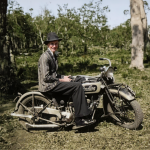
The Koch motorcycle of 1934 and 1935 was the final chapter in one of the more distinguished engineering careers in the history of Central European motorcycle design, and the machines themselves represented a direct continuation of work that had already produced some of the most technically advanced motorcycles built in Czechoslovakia.
Jaroslav František Koch was a talented Czechoslovakian designer who, in an era in which such engines were uncommon, believed in the potential of overhead camshaft engines. Koch’s first motorcycle was named the JFK, built in 1923 with a 350cc OHC engine in which the crankshaft ran longitudinally. In 1926 he was recruited by BD, the Breitfeld-Daněk company, for whom he designed a double overhead camshaft 500cc engine with a technique then without precedent. In 1928 the first Praga BD 500 rolled out of the Breitfeld-Daněk factory in Prague. It was an advanced four-stroke single-cylinder unit construction double overhead camshaft model designed by Koch. Koch himself rode the machine from Rome to Prague, covering 1,480 kilometres in 35 hours and 40 minutes, setting a new endurance record. In 1929 Praga merged with ČKD, one of Czechoslovakia’s largest engineering companies, and the BD motorcycle was re-branded under the Praga marque. In 1932 Praga added a second model, the BC, which had a single overhead camshaft engine of 350cc, shaft drive and a pressed steel frame.
Praga ended production of both motorcycle models in 1933. When Praga ceased motorcycle production the chief designer, J.F. Koch, established a factory building limited numbers of advanced OHC machines. Koch returned to developing his own machines and produced a four-speed 350cc OHC motorcycle under the Koch brand based on the Praga 350cc OHC cardan model. In 1935 he accepted an offer to join CZ.
The Koch motorcycle of 1934 and 1935 was therefore a machine of genuine technical substance, not a speculative venture by an unknown assembler but the work of the engineer who had designed the most advanced Czech motorcycles of the preceding decade. The OHC engine and shaft drive configuration it carried forward from the Praga BC placed it well beyond the technical level of most small-batch production at the time. That production was limited in numbers and lasted only two years reflects the commercial reality facing any independent manufacturer attempting to sustain a sophisticated machine through hand-built production in the mid-1930s, in a market where the established factories had decisive advantages of scale and distribution. Koch’s decision in 1935 to accept the CZ offer was the practical resolution of that situation, and it brought his considerable engineering talent into the service of a manufacturer with the resources to use it at greater scale. The Koch marque, like the JFK before it, was a vehicle for one man’s engineering convictions in the years between institutional appointments.