KNIGHT | 1894, 1896 | UK :
John Henry Knight of Farnham, Surrey, was one of the more remarkable figures in the early history of British motoring, and his place in that history rests not primarily on the machines he built but on the legal and political consequences of driving one of them through the streets of his own town. Knight was born into a wealthy family in Farnham in 1847. Trained as an engineer, he became a serial experimenter. His inventions included a steam powered digging machine, a speedometer, wooden vehicle tyres, a grenade thrower, and a patented dish lever for tilting plates when carving meat. In 1868, aged 21, he built a four-wheeled steam-powered carriage capable of carrying three passengers with a top speed of eight miles per hour.
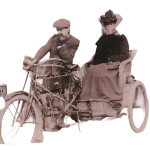
J. H. Knight built a steam road carriage in 1868, and in 1894 built a steam-powered tricycle. In 1896 he displayed a petroleum-engined three-wheeler at the Crystal Palace Show which had a two-speed gear and a single front-wheel with tiller steering. This machine was produced in limited quantities before being converted to four wheels.
In 1884, Knight had a breakthrough when he successfully vaporised paraffin oil, leading to the development of the first oil-driven engine. The profit that he made from the patent enabled him to experiment further, and in 1895 he built a single cylinder, 1565cc, two-seater petroleum tricycle, reportedly capable of reaching seven and a half miles per hour, whilst being almost silent when running.
The vehicle brought Knight into direct and consequential conflict with the law. In 1895, with his assistant James Pullinger, they drove through Farnham, Surrey, whereupon he was prosecuted for using a locomotive with neither a licence nor a man walking in front with a red flag. This is sometimes misreported as the first person to be convicted of speeding in the UK. Knight and Pullinger were both fined half a crown plus costs. Knight was restricted to using the car only on farm roads until the Locomotive Act was replaced by the Locomotives on the Highway Act on 14 November 1896.
After travelling some 150 miles on public roads, development was prevented from further progress by the authorities. Knight was instrumental in the introduction of motorised vehicles to Britain. A founding member of the Automobile Club of Great Britain, the first ever club run was hosted at his Barfield home. Knight was both an inventor and pioneer, having created a renowned steam powered hop digger, a heat saving radiator, a brick laying machine, a grenade thrower, a speedometer, wooden vehicle tyres, and a patent dish lever for tilting plates when carving meat. Knight was also a pioneer of colour photography, and his photographs are described as an important record of Farnham.
The Knight machine that appeared at the Crystal Palace Horseless Carriage display in 1896 was, for a moment, the only British car at that exhibition. That distinction, and the legal prosecution of 1895, are the two events that gave Knight his place in British motoring history. The vehicles themselves, a steam-powered tricycle of 1894 and a petroleum-engined three-wheeler of 1896, were the instruments of that history rather than the substance of it.