KNAP (See Georgia Knap) | 1902 | France :
The Knap motorcycle is entered in some references under the manufacturer’s own family name, but the machines were sold commercially under the brand name Georgia Knap, after their maker Marie-Georges-Henri Knap of Troyes, and readers seeking the full entry will find it under that heading.
Marie-Georges-Henri Knap showed excellence as a mechanic, electrician, inventor of household appliances, architect, composer, horticulturist, specialist in cellular biology and healer. His activities in the world of personal transport started in 1888 when he founded a bicycle repair shop. Some years later he stepped into the quickly developing world of the automobile and published an authoritative work on the design and manufacture of petrol engines.
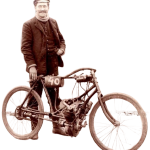
In 1898 his design of a light car was bought by a Belgian company in Liège that produced the Knapp tricar, a vehicle much like the Léon Bollée. Knap’s design was sold in Britain as The Tourist. To oversee production Knap moved to Liège but he returned to Troyes some years later to focus on a new field of interest for him, the motorcycle. The first models were brought out in 1902 and production lasted till 1905.
Knap was convinced that the most practical position of the engine would be close to the rear wheel so no troublesome chain or belt would be needed for power transmission. This direct drive would also diminish power loss in the transmission; Knap claimed that 90% of the engine power was actually available at the rear wheel. The Knap motor weighed 6 kilograms and a half, ran normally at 2,400 revolutions per minute and drove directly by a pinion and a gear wheel the hub of the rear wheel, near which it was mounted vertically.
At the 1902 Paris Salon, Georgia Knap of Troyes showed the Knap gear-driving motor-bicycle in three powers, three-quarter, one and a quarter and two horsepower. The one and a quarter and two horsepower machines had duplicate forks and Bowden brakes fitted, and Dunlop tyres on Westwood rims. The light touring machine had the tanks cased over with a canvas cover.
In 1903, three models could be had in capacities of half horsepower, one and a quarter horsepower and two horsepower. Gear sets were available in several ratios so that the machines could be used in various road conditions. After a somewhat hesitant start Knap’s machines became successful in various endurance trials and quite a few were sold. In the 1903 sales brochure the company proudly stated that between May and December 1902 four hundred machines had been sold.
As Knap went on he refined his idea, notably with the Model C, four times more powerful than that of 1902. But Knap had an insatiable curiosity and abandoned production of his motorcycle in 1905 to plunge into new projects. In 1906 he built an electrical house, then got involved with cellular biology, and was involved in public housing projects even before the war of 1914. After that, the trail of this inspired inventor goes cold, and only two examples of his motorcycles are known to survive.