KINGSWAY | 1921-23 | UK :
The Kingsway was one of many small Coventry-built motorcycles that emerged in the years immediately following the First World War, assembled from proprietary components in what was then still the heartland of British motorcycle manufacturing.
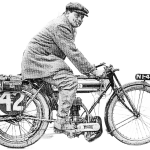
Kingsway was a motorcycle produced in 1920 by the Kingsway Motor Cycle Co of Stoke, Coventry. The machine was a lightweight fitted with a 269cc two-stroke Arden engine, CAV magneto, B and B carburettor, Best and Lloyd lubricator, Lycetts leather pan saddle, and either direct-belt drive or a two-speed countershaft gearbox with chain-cum-belt. Its only distinguishing feature was a Y spring fork in place of a better-known proprietary item. Neither the fork nor the Kingsway make survived for very long.
The Arden engine that powered the Kingsway had its origins in a well-established Coventry district business. The Arden Motor Company was situated at Berkswell, near Coventry, and was first known for cyclecars and light cars. After World War I they developed and marketed a spring front-fork with side members from pressed steel, with adjustable links on cup-and-cone bearings. They also produced a 269cc two-stroke engine, and that engine and the fork were used by several smaller assemblers such as Endurance, Gaby, Norbreck and Priory. The Kingsway was therefore drawing on the same engine supply as several other small makers of the same period, all of them attempting to find a place in the market for cheap, lightweight personal transport that the post-war years had briefly seemed to offer.
The 269cc displacement was a standard size for the lightest class of two-stroke in the British market at this time, appearing not only in the Arden unit but in the Villiers engine that powered many competing machines. A contemporary press notice described the Arden-engined two-stroke model as similarly equipped to comparable machines of the period, offered at £36 for single gear, £42 with two-speed, and £46 with clutch and kick-starter.
The Y spring fork that the Kingsway used in place of better-known proprietary items such as Druid or Brampton was presumably of local Coventry manufacture, though its exact origin is not recorded. That it warranted a specific mention as the machine’s only distinguishing feature suggests it was novel enough to attract comment, but not substantial enough in design or performance to establish itself against the established fork makers.
Stoke was an inner suburb of Coventry, and the Kingsway Motor Cycle Co operated there at the beginning of what proved a particularly difficult period for small assemblers. Coventry in 1920 and 1921 had more motorcycle manufacturers per square mile than almost anywhere else in Britain, and the competition for the lightweight market was intense. The combination of that competition, falling post-war demand, and the mechanical anonymity of a machine whose only distinguishing feature was an obscure proprietary fork ensured that the Kingsway’s time in the market was brief.