KINGSBURY | 1919-23 | UK :
The Kingsbury scooter arrived on the market at the same moment as a wave of similar machines, produced by a company that had built aircraft only months before and needed urgently to find something else to make.
Kingsbury Aviation had a contract to build 150 Airco DH.6 training biplanes for the Royal Flying Corps, and by mid-1918 it employed 800 people on the site. The company had a contract to build 20 Vickers Vimy biplane bombers, but with the end of the First World War the government contracts were cancelled. The Barningham brothers, Ernest and Harold, who had established the engineering business and created the aviation subsidiary at their Kingsbury aerodrome site in north-west London, were left with a large workforce and no military orders. After the war they switched to scooter and motorcycle manufacturing in order to remain afloat.
Kingsbury scooters were built from 1919 to 1922 by Kingsbury Engineering Co. Ltd., who built some 150 DH6 aircraft during WWI. The machines were sold by London and Midland Motors of London W1.
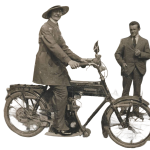
The first model entered the market after the end of World War I. It had a 2hp two-stroke engine at the front of the platform frame. The rear wheel was driven by chain via a countershaft, it had disc wheels with brakes, and front suspension by plungers. Riders had to stand, but a seat later became an option. The technical details of the engine were described in the contemporary press: the cylinder and crankcase formed one casting, the crankshaft carried an external steel flywheel on the near side and ran in phosphor-bronze bearings, and the weight of the power unit less magneto and carburettor was under 15 pounds. Ignition was by a CAV magneto and the carburettor was a standard Amac unit.
In 1920 a lightweight motorcycle joined the scooter. Conventional in design, it was powered by the same 254cc two-stroke engine, but with two-speed transmission by chain and belt through the maker’s own gearbox.
By 1920 a share issue had been floated to acquire the business and assets of Barningham, carried on at the Kingsbury Engineering Works covering 109 acres. The board included Admiral Sir P. Scott, Bt., as Chairman, and Ernest Barningham as a director. The company produced not only motorcycles and scooters but also light Kingsbury cars. The enterprise was ambitious in scope and backed by some credible names, but the commercial reality was unforgiving. The scooter craze that had seemed so promising in 1919 deflated almost as quickly as it had inflated, as buyers found that standing on a small platform behind a two-stroke engine was less appealing in practice than in publicity photographs. In 1921 interest in stand-up scooters began to wane and the original Kingsbury scooter went out of production.
The company went into liquidation in 1921. After a few years of being empty, the aerodrome and hangars were purchased by Vanden Plas to build motor car bodies. Two years later, the vacant hangars were leased by the owners of coachmakers Vanden Plas, who built luxury bodies for automobiles. They also built racing cars, and the winners of Le Mans from 1927 to 1930 were prepared in the Vanden Plas factory, designed by W.O. Bentley. The factories returned to aviation production in WWII and built wings for the twin-engined Mosquito fighter-bombers.
The Kingsbury scooter therefore occupied a brief three years of a site whose wartime aircraft hangars had in different circumstances sheltered both the machines of a small manufacturer trying desperately to survive the peace and, subsequently, some of the fastest cars in the world.