KILLINGER & FREUND | 1938 | Germany :
The Killinger and Freund motorcycle occupies a singular place in the history of German engineering: a machine of genuine technical ambition, executed to a refined standard, that never reached the riders it was designed for because history intervened.
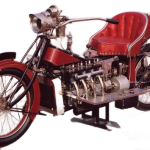
To understand what the five Munich engineers were attempting, it is necessary to understand what inspired them. The famous Megola was created by Meixner, Gockerell and Landgraf, whose initials formed the name. Built in Munich from 1921 to 1925, it had a 640cc five-cylinder rotary sidevalve 14hp engine mounted within the front wheel. The Megola had no clutch. To start the engine, the rider had to either spin the front wheel while the cycle was on its stand, or push-start the cycle. The owner’s manual suggested the rider make small orbits in the road if at any point the bike had to halt. Despite this considerable operational inconvenience, the Megola was successful in competition. Toni Bauhofer clocked 142 km/h at the AVUS circuit in Berlin on a Megola racing machine. In 1924, Bauhofer won the over-500cc class on a Megola at the German Motorcycle Road Championship, defeating the entire BMW works team.
In 1935 a group of five German engineers from Munich, the main designers being Killinger and Freund backed by three technicians, began designing a more streamlined and modified version of the Megola front-wheel drive motorcycle. The work took three years to complete. The engine displacement stayed the same as the Megola at 600cc but was much lighter and more simplified than a standard 100cc motorcycle of the time.
Where the Megola had used a five-cylinder rotary sidevalve unit without clutch or gearbox, the Killinger and Freund featured a three-cylinder two-stroke engine built right into the front wheel, with transmission and clutch, and more comfortable front and rear suspension. The clutch was located in front of the transmission, actuated by foot-operated steel cables. The rear suspension used telescopic oil-filled shock absorbers. All parts of the engine allowed easy access for service work. After the removal of the engine, which required only two bolts and some wiring to be disconnected, all important parts were within reach. The tyre could also be removed easily by unlocking a safety mechanism and removing the tyre completely with the split rim.
The aesthetic philosophy was as considered as the engineering. What Killinger and Freund completed was more than an improved Megola. The engine displacement was again 600cc and the total weight an impressive 135 kilograms including fuel. The bike looked elegant and thrilling. There was always a crowd of people around the displayed bike, indicating that something great was happening. Most of them liked the shape. That was important because the technicians wanted to build a bike that could be sold in large numbers some day. The people were used to aerodynamic shapes of car bodies and it seems they already expected something like that.
The resulting prototype, completed and tested by 1938, was showcased in the German Motorrad magazine that October, highlighting its aerodynamic enclosure, enclosed wheels for dirt protection, and advanced suspension system including a telescopic front fork with 80mm of travel and rear oil-filled shock absorbers.
This design was intended for civilian production but the start of World War II cancelled those plans. One motorcycle was discovered by the US Army in the spring of 1945 at a German military installation, but it is not known if this was the original prototype or another Killinger und Freund Motorrad. It was sold as scrap in the United States after a short period of display. A machine that crowds had gathered around in admiration in 1938 ended its days as salvage metal in a country that had no reason to know what it was looking at.