KIEFT | 1955 to 1957 | UK :
The Kieft name on motorcycles and scooters belongs to a man whose primary reputation was built on something entirely different, and the two-wheeled episode in his commercial life is best understood with that context in place.
Cyril Kieft was born in Swansea and spent his early working life in the steel industry. After the Second World War he started up his own company, Cyril Kieft and Co Ltd in Bridgend, Glamorgan, making forgings and pressings including components for the motor industry. He had an interest in motor racing and, when the Formula Three car manufacturer Marwyn failed, he bought their designs and used them as a base for his own 500cc car. A new design by Gordon Bedson, who had joined the company from the aircraft industry, was produced in time for the 1951 Whit Monday Meeting at Goodwood where it won the Formula Three event driven by Moss. Don Parker won the 1952 and 1953 Autosport championship driving a Kieft, while Ken Wharton and Bernie Ecclestone were other noteworthy exponents.
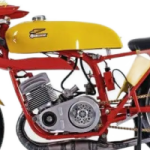
By 1955, with the racing car chapter of his career largely behind him, Kieft turned his attention to the booming market for lightweight two-wheeled transport. The machines were produced by the Hercules concern in Germany and assembled by Cyril Kieft’s Wolverhampton firm from 1955 to 1957. The connection to motor racing remained at arm’s length: Cyril himself had designed and built a speedway bike, a Kieft moped with a Sachs 50cc engine which went into production, and a Villiers-powered scooter which sold 1,000 examples under the names of Kieft and DKR.
In 1955 and 1956 these machines were typical of the decade. The moped had a Fichtel and Sachs two-stroke, two-speed engine unit hung from a pressed-steel spine frame. There was no rear suspension, but it had rubber in torsion to the front wheel. The scooter had a 191cc Sachs engine, four speeds, electric start and typical bodywork. Kieft Cars of Wolverhampton announced a price of £77 10s for the imported Sachs-powered Kieft moped at the 1955 Earls Court Show.
In 1957 the range was extended and two scooters were added, with 147cc or 197cc Villiers engines. The original moped was joined by one with rear suspension. There was also a Hercules motorcycle with a 200cc Ilo engine. The Kieft 150cc Villiers scooter was listed £57 cheaper than the 200R Sachs scooter, and would have been competitively priced against imported Italian Lambrettas and Vespas, however the Hercules and Villiers Kiefts never went into production.
The explanation lay in Kieft’s next venture. Cyril Kieft was already engaged in Plan C, and discussions with Willenhall Motor Radiators of Wolverhampton were leading to the final designs of a new all-British scooter. The DKR Company was established in 1957, taking its title from the initials of Messrs Day and Robinson of Willenhall Radiators, and Cyril Kieft. DKR was formed in 1957 by Barry Day and Noah Robinson, who were directors of the Willenhall Motor Radiator Co, and industrialist Cyril Kieft who also built racing cars. The company was run from premises at Pendeford Airport. The first model was launched in July as the Dove, a stylish if somewhat weighty machine fitted with a 147cc Villiers 30C engine, fan cooling and a three-speed gearbox.
In September 1957, distribution of the German Hercules products shifted to BP Scooters of Wolverhampton and the machines were then sold under the Prior name. The Kieft name on two wheels therefore lasted barely two years, a brief commercial interlude between the racing cars of the early 1950s and the DKR scooters that would prove rather more durable.