KENILWORTH | 1919-24 | UK
The man at the centre of the Kenilworth story is one of the more remarkable engineers to emerge from the early British motor industry, a figure who moved from aircraft components through car engineering and motorcycle design before spending his retirement redesigning the iron lung. George Thomas Smith-Clarke was born in Bewdley in 1884. He joined the Great Western Railway in 1902, and in 1905 was transferred to the GWR Road Motor department, working his way through the various shops to the drawing office. At the outbreak of the First World War he was commissioned in the Royal Flying Corps, was promoted to captain in April 1917, and did a great deal of design work on military aircraft.
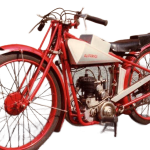
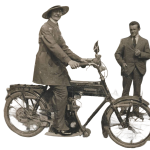
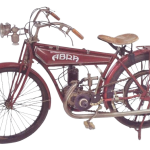
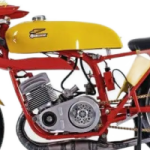
The Kenilworth motorcycle grew directly from a personal project. In 1919 Smith-Clarke designed and built a motorcycle for his wife, which was then put into production firstly by Booth Brothers of Much Park Street, Coventry, and then by Kenilworth Utility Motors, also in Coventry. This first machine was a small motorcycle with a central engine and 18-inch wheels, front and rear suspension, and some panelling to enclose the rear wheel. Without a saddle it had the open frame of a scooter. It was fitted with a 142cc Norman four-stroke engine, driven by Whittle belt to a countershaft with chain final-drive.
The Kenilworth’s original specification was noted in contemporary press coverage. The 1919 model was described as a 1.25 horsepower Norman with a 55 by 60mm, 142.5cc single-cylinder four-stroke overhead-valve engine, drip-feed lubrication, single-lever carburettor, Runbaken direct-driven magneto, single-speed gear, and belt and chain drive on Kenilworth 18 by 2-inch tyres, priced at £52 10s.
The machine evolved steadily across its production life. On the Kenilworth scooter the seat and footboards were sprung in unison, giving a coordinated suspension that was unusual for the period. In late 1920 the Kenilworth Miniature was introduced, which was essentially the scooter with a sprung seat pillar, saddle, battery-powered electric lighting and two brakes, the rear being the contracting band type. The introduction of the Motorcyclette in 1921 saw a redesigned fully tubular frame with swept-back handlebars and leg shields. In 1923 a handle starter was fitted, when the transmission changed to friction with variable ratios, and a three-wheeled box carrier model was devised. In 1924, although the Kenilworth had outlasted most of its competitors, production ended during that year.
From known engine numbers, approximately five hundred and fifty Kenilworths were produced over five years. There are ten known survivors, some incomplete and others in museums, consisting of three scooters, three miniatures, three motorcyclettes and four friction drives. As far as is known only three of these are complete and in road use.
By the time production ended, Smith-Clarke had already moved on to larger responsibilities. After the war he joined Daimler as assistant works manager, and in 1922 moved to Alvis, T.G. Johns’s new luxury car company, to become chief engineer. He remained with Alvis until his retirement in 1950. The work that Captain Smith-Clarke accomplished in the years since his retirement became widely known for it was concerned with the development of various kinds of mechanical appliances to improve medical treatment. He is acknowledged as a pioneer of modern research into mechanical breathing apparatus, particularly the iron lung. During the polio outbreak of the early 1950s, after witnessing a woman patient in distress while undergoing nursing care inside a conventional iron lung, he set up a Coventry team to make modifications to the wooden iron lung. This resulted in orders from the Ministry of Health for kits to modify all iron lung ventilation machines in Britain. Smith-Clarke then designed a radical new version called the Coventry Alligator iron lung and continued in the field of medical engineering for the rest of his life.
The Kenilworth, a machine built originally for one woman’s personal use and then sold to fewer than six hundred buyers, was an early chapter in a life of exceptional breadth and public usefulness.