KEMPISTY | 1929-39 | Poland :
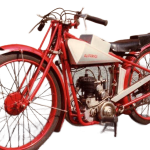
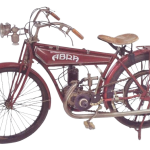
Kempisty motorcycles were manufactured by Jan Raczynski in Warsaw from 1929 to 1939. These were 50cc auxiliary bicycle engines mounted within the triangle of a strengthened bicycle frame.
In 1935 there were 0.7 motor cars per 1000 inhabitants in Poland, as contrasted with 11.9 in Germany, 22.6 in Sweden, and 7.4 in Czechoslovakia. Between 1931 and 1936 the number of automobiles in Poland decreased progressively from 38,800 to 24,700. Bicycles were much used. In this environment, a motorised bicycle offered precisely the kind of incremental step up that was financially within reach for people who could never contemplate a full motorcycle or motor car.
Raczynski was not alone in recognising this market. Stefan Malcherek had established the SM Workshop in Poznań in 1924, manufacturing a 50cc auxiliary engine that could be fitted to a bicycle and was mounted above the front wheel, driving it by means of a roller. The two approaches differed in their engineering logic: where Malcherek mounted his engine externally at the front wheel, Raczynski placed the Kempisty’s engine within the diamond of a reinforced bicycle frame, a configuration that kept the centre of gravity lower and the overall proportions closer to a conventional bicycle. In the second half of the 1930s, several domestic Polish factories started producing small-engine motorcycles, popularly known as Setki (hundreds). Vehicles of this type were cheap, economical and quite durable, and were favourably received by motorcyclists. The Kempisty, though smaller than the 98cc machines that dominated the Setki category, belonged to the same philosophy of accessible, practical motorised transport.
Jan Raczynski produced his machines across a full decade, from 1929 until the German invasion brought Polish civilian industry to a halt in September 1939. When Poland was attacked by both the Germans from the west and the Russians from the east, the motorcycle industry, along with all others in Poland, came to a halt. The Kempisty, like every other Polish marque of the period, ended not through commercial failure or technical obsolescence, but through the violent erasure of the world in which it had been built.