KG | 1919-32 | Germany :
A note on the brief: the KG marque is not the product of Kirchheim & Co of Magdeburg, and the machines were not 100cc two-strokes or 250cc horizontal twins. KG stands for Krieger-Gnädig, and the machines built under that name were among the most technically distinguished motorcycles produced in Germany between the wars.
The Krieger brothers, Karl, Oskar, Max and Peter, were natives of Berlin who became quite adept at aviation during the pioneering days. Karl received pilot’s licence number 113 in 1911. Like motorcycling, flying has its dangers, and Karl was killed on a test flight during the latter years of the Great War.
The aviation industry subsided considerably subsequent to the armistice and the remaining three brothers turned their talents to motorcycling, a not uncommon occurrence. The links between aviation and motorcycling are substantial, as the two endeavours have common themes: a love of sport, speed, danger perhaps; similar skills of balance, speed and distance judgement; and a keen interest in mechanics.
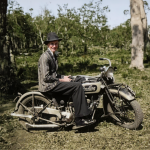
Technical designer Franz Gnädig joined the business and a factory was established in Suhl in December 1919. Development began on several, perhaps six, prototypes, and the first of these saw light in April 1920. These early machines had engines with overhead inlet valves and side valve exhaust, but production models had 80 by 99mm OHV dry sump engines, robust triangulated frames, quickly detachable interchangeable wheels driven via a three-speed gearbox and shaft drive. They were the first German machines with a cardan system. This placed the KG several years ahead of BMW in adopting shaft drive, a point of considerable historical significance.
Early models had cast iron pistons and were capable of 3,000rpm, soon replaced with aluminium alloy pistons good for 4,300rpm. By June 1921 they had produced one hundred motorcycles, and competition success was accumulating in both road racing and reliability trials. In 1921 the Kriegers achieved 22 victories in competition.
The early twenties in Germany were years of economic chaos, and demand for expensive machines like the quite brilliant KG slowed. The firm was in trouble, and in 1922 the factory was absorbed by Cito of Cologne, which built the Cito-KG. Cito in turn was acquired by Allright in 1923, but the writing was on the wall when BMW released its first machines shortly thereafter, and the Allright-KG was dropped from the catalogue. Production of the KG continued at the Henkel factory until 1932.
The design also appeared as the Blackburne-engined Original-Krieger built by the Krieger brothers in 1925, and as the Gnädig of 1924. Gnädig himself joined Diamant in 1926 and later moved to Opel. The KG therefore passed through the hands of at least four different producers across its thirteen-year life, each carrying forward a design that was technically ahead of its time but consistently too expensive to manufacture at a scale that could survive the economic conditions of Weimar Germany.