KUROGANE | 1930-40s | Japan :
Kurogane, a name meaning black iron, was a brand of the Japanese firm Nihon Nainenki, a company also recorded as Nippon Nainenki Seiko and later as Tokyu Kurogane Industries. The name was applied to military vehicles of two quite different kinds during the 1930s and 1940s, and both are bound up with the Imperial Japanese Army’s wartime needs.
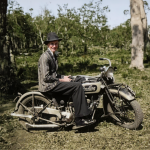
The motorcycle side of the story grew directly out of a shortage of supply. When Japan entered the Second Sino-Japanese War in 1937, the Shinagawa works could not satisfy the heightened demands of the military, so the Army signed a contract with Nihon Nainenki to manufacture 1,200cc flathead motorcycles under the Kurogane name. These were heavy sidecar machines whose flathead V-twin engines followed the Harley-Davidson pattern, since the licensed Harley design was already the basis of Japan’s standard military sidecar motorcycles. Harley-Davidson had long supplied the market with its flathead engine, used in a range of makes and models, and as war approached and Japan turned inward the military took control and contracted Nihon Nainenki to supply the sidecar-equipped Kurogane in service of the Emperor. Such outfits were used in the roles your draft describes, carrying officers, delivering dispatches and moving supplies.
The most famous Kurogane product, however, was not a motorcycle at all but a small four-wheel-drive car. The Kurogane Type 95 was a Japanese scout car built by the firm, used in the war with China and in the Pacific War, with approximately 4,700 produced between 1936 and 1944, and it was the only completely Japanese-designed reconnaissance car used by the Imperial Japanese Army, nicknamed the Yonki, meaning all-wheel drive, and called the daruma by soldiers in the field. It carried three people, used a two-cylinder air-cooled four-stroke V-twin engine developing 33 horsepower at 3,300 rpm, an advantage in the cold of China, and drove all four wheels through a gearshift-operated transfer case, giving it far better off-road mobility than the Type 97 motorcycle the Army also used. It was conceived in 1934, served from 1937 in China and at Nomonhan in 1939, and went on to all the continental campaigns of the Pacific War as a reconnaissance, supply and staff vehicle, built in roadster, pickup and four-door phaeton forms