KTM | 1953- | Austria :
KTM did not begin as a motorcycle manufacturer at all, but as a small metalworking and repair shop in Mattighofen. Hans Trunkenpolz founded Kraftfahrzeug Trunkenpolz Mattighofen in 1934, selling DKW motorcycles and later Opel cars, and during the war the business survived largely on diesel‑engine repairs, kept running by his wife while he served. When that work evaporated after 1945, Trunkenpolz turned to building a motorcycle of his own.
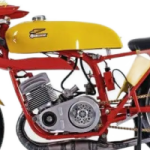
The move into motorcycle production unfolded in two stages. In 1951 he produced the prototype of the R100, built almost entirely in‑house apart from its 98cc Rotax engine supplied by Fichtel & Sachs. Series production followed in 1953, with a workforce of just twenty employees turning out three machines a day. This distinction matters: the R100 was a 1951 prototype that only reached full production two years later, and its engine was bought in rather than designed by KTM.
The decisive step came that same year, when the businessman Ernst Kronreif became a major shareholder. His investment gave the company both capital and its enduring name: Kronreif & Trunkenpolz Mattighofen, conveniently preserving the KTM initials. With that, the range expanded quickly. The R125 Tourist appeared in 1954, followed by the Grand Tourist and the Mirabell scooter in 1955. KTM took its first national racing title in the Austrian 125cc championship, won a gold medal at the 1956 International Six Days Trial, and launched the Trophy 125 sports bike in 1957. The international reputation that later surrounded the marque rested above all on this off‑road and competition success, not on its road models alone.
The company’s first great crisis arrived in the late 1980s. Sales of scooters and mopeds collapsed, production stopped in 1988, and Erich Trunkenpolz died the following year. The original company went bankrupt and was broken into separate radiator, bicycle and motorcycle divisions. Out of this restructuring came a new entity: KTM Sportmotorcycle GmbH, founded in 1992 with new management, a new hard‑enduro model and a fresh design direction. Your summary of the period is essentially correct, with the added clarity that the old firm failed outright and the motorcycle business was formally refounded in 1992.
The modern KTM was shaped above all by one figure: the Austrian industrialist Stefan Pierer. He took over the insolvent but debt‑free motorcycle division in 1992, employing 150 people and selling 6,500 motorcycles in his first year. He had already acquired parts of the old KTM Motor‑Fahrzeugbau in 1991, the company that would become KTM AG in 2005. Known as a specialist in turning around troubled firms, Pierer built a group of performance brands around KTM. Through what became Pierer Mobility AG he acquired Husaberg and later Husqvarna Motorcycles, moved Husqvarna’s production to Austria, brought WP Suspension and GASGAS into the fold, and in 2023 took a controlling stake in MV Agusta. Husqvarna joined the group in 2012, GASGAS in 2019, and both flourished on the back of intensive motorsport activity. The whole enterprise ran under the slogan “Ready to Race.”
Racing was not an accessory to the brand but its core identity. KTM competed for world titles across all three Grand Prix classes, dominated the Motocross World Championship and American Supercross, and won the Dakar Rally eighteen times in succession. In 2017 it entered both Moto2 and MotoGP with its own machines. Between 2011 and 2019 the group invested roughly 250 million euros in factories, R&D and racing, hired 2,000 additional employees, and opened the Motohall museum in Mattighofen at a cost of about 35 million euros.
A second pillar of the modern strategy was the long partnership with Bajaj Auto in India. Bajaj first invested in 2007 and gradually increased its stake, giving KTM access to affordable small‑capacity production for emerging markets in Asia and South America. The combination of racing prestige, a strong road range and inexpensive Indian‑built entry models pushed KTM to the top of the European industry. The company sold a record 381,555 motorcycles in 2023, though profits had already slipped from 235 million to 160 million euros — an early sign that growth was beginning to outpace returns.
The reckoning came abruptly at the end of 2024. KTM was burdened with heavy debt and warehouses full of unsold motorcycles — more than 300,000 of them — after production had continued at high levels despite weakening demand. On 29 November 2024 the company filed for self‑administration in Austria, a structured form of insolvency. Revenue fell 29 percent to around 1.9 billion euros, operating earnings collapsed, and thousands of creditor claims were lodged. KTM reportedly owed more than a billion euros to 180 banks. The court‑supervised restructuring aimed to produce a plan within ninety days. Creditors ultimately accepted a settlement in which they received 30 percent of their claims — a total of 548 million euros — with the remaining 70 percent forgiven. Manufacturing had been frozen since January 2025, and the plan called for production to restart gradually from mid‑March.
The rescue came from India. Bajaj Auto stepped in with a 450 million euro loan in May 2025 through its subsidiary Bajaj Auto International Holdings, part of a broader package of around 800 million euros that funded the restructuring. On 18 November 2025 the same subsidiary purchased all shares of Pierer Bajaj AG, ending the Pierer family’s control and giving Bajaj a 74.9 percent stake in Pierer Mobility AG — effectively full control of KTM, Husqvarna and GASGAS. The corporate identity changed accordingly. Pierer Mobility AG became Bajaj Mobility AG on 13 January 2026, with a new logo, while KTM’s headquarters remained in Mattighofen.
The new owners quickly shed everything outside the core motorcycle business. KTM sold the Felt bicycle brand, discontinued the X‑Bow road‑legal track car, ended its partnership with MV Agusta and stopped distributing CFMOTO in Europe, concentrating solely on KTM, Husqvarna and GASGAS. In early 2026 KTM AG completed its financial restructuring by securing an unsecured 550 million euro loan from an international banking consortium, refinancing the money Bajaj had advanced the previous year.
The recovery remains delicate. For 2025 KTM reported revenue down 46 percent year on year to about 1.009 billion euros, with sales falling around 28 percent. Husqvarna and GASGAS also declined sharply, and MV Agusta had already been cut loose. Yet the racing programme — the heart of the brand — survived even the worst of the crisis. Chief executive Gottfried Neumeister pointed to a Dakar Rally win, six consecutive American Supercross victories and three further world titles in 2025, arguing that once the inventory overhang was cleared the company could return to profitability. He also expressed confidence that KTM would remain an Austrian company despite Indian ownership.
That long arc is what makes KTM so compelling to document. It grew from a one‑man workshop in 1934, survived bankruptcy to be reborn in 1992, rose to become Europe’s largest motorcycle manufacturer and one of the most successful competition marques in history, and then, after a near‑fatal overreach in 2024, passed into the hands of the Indian partner that had supported it for nearly two decades.