KÖNIG | 1971-76 | Germany :
The story of König Motorenbau is one of the most unlikely and quietly magnificent in all of motorsport. Rudolf König founded the company in Berlin in 1927, beginning as a small workshop producing simple one-horsepower motors. Those early engines were humble side-mounted units, originally conceived as auxiliary drives for sailing boats caught without wind, but Rudolf König had an engineer’s instinct and an eye for what a two-stroke engine could become. Within a few years, König Motorenbau had transformed the world of outboard racing, proving that lightweight, high-revving two-stroke engines could outperform the heavier, more complex four-stroke designs of the era. In 1935, the company introduced the legendary König “J” engine, which set two straightaway world records that remained unbeaten for eighteen years.
After the Second World War, Rudolf’s son Dieter rebuilt the company alongside his father and steered it toward increasingly serious racing applications. During the 1960s, 1970s and 1980s, Dieter König’s engines dominated hydroplane racing. The statistics bear that out in extraordinary fashion. Up to and including 1999, a total of 130 world championship titles were awarded in the displacement classes 250cc, 350cc, 500cc and 700cc on the water, and 115 of them went to drivers powered by König engines. That is a record of dominance that few manufacturers in any motorsport discipline have ever matched.
What makes the König story truly remarkable, however, is that it did not stay on the water. In the 1950s, König engines were adapted for speedboat racing in the USA and performed exceptionally well. A motorcycle engine was later developed for sidecar racing, and the four-cylinder boxer two-strokes powered many machines to victory during the 1970s. The transition to Grand Prix motorcycle racing came about through a chain of events that reads more like a work of fiction than history.
It was while working as a marine engine mechanic for Bob Jackson in Melbourne that Kim Newcombe was introduced to the König racing outboard motor. The König was a 494cc two-stroke flat-four boxer-layout engine that made impressive power and performed well in hydroplane racing. Newcombe was immediately taken by the simple and powerful König engine, and wanted to meet the man behind the design. In 1968 he got his wish and was introduced to Dieter König, who offered him a position at the König factory in Germany.
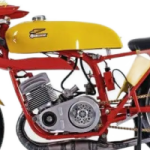
Newcombe was a New Zealander born in Nelson in 1944, a man of remarkable natural talent who had competed in motocross and speedway across New Zealand and Australia. A German racer named Wolf Braun had built a motorcycle chassis around a König 500cc four, but was forced to abandon the project due to injury. Dieter asked Kim to take over development, and Newcombe promptly devoted himself wholeheartedly to the endeavor. It was an extraordinary ask. The engine was, after all, designed to push a boat through water, and fitting it into a racing motorcycle required a complete rethinking of its cooling, transmission, and packaging. Newcombe adapted the engine for land racing by adding a custom radiator system, a Norton six-speed gearbox, and a lightweight racing chassis.
The horizontally-opposed rotary-valved engine appeared on the track in solo form in 1971, ridden by John Dodds of Australia, and then with Newcombe in 1972. The debut was sensational. Newcombe surprised everyone by winning his first ever road race, creating the first winning post-war German-made motorcycle. So raw was his talent that he finished on the podium behind the factory MV Agustas in his first ever Grand Prix, the 1972 West German GP at the Nürburgring, acting as a one-man operation, working as both rider and mechanic.
That result was enough to convince Dieter König to continue. For 1973, the König had a new frame and more horsepower. Newcombe had his old Australian mate Rod Tingate as his mechanic, who he had convinced to join him and his family as Team König. They were up against the might of the MV Agusta factory, with Giacomo Agostini and Phil Read on the works machines, and the new factory Yamaha effort led by the brilliant Finn Jarno Saarinen. Saarinen, who had won the first two races of the season in France and Austria, was killed at Monza while racing in the 250cc Grand Prix in May. Yamaha withdrew from the series for the rest of 1973. It left the championship wide open.
Newcombe subsequently won the Yugoslavian Grand Prix and topped the 500cc standings. He took fifth at Paul Ricard in France, then broke through with a third place in Austria behind Saarinen and Agostini. The season built to something that felt genuinely historic. A privateer, operating with a skeleton crew, on a machine originally designed for boat racing, was threatening to bring down one of the great factory efforts in the sport. Then came the tragedy.
At a non-championship 1000cc event at Silverstone, Newcombe led the first six laps before the overpowered König’s brakes failed at the entry to Stowe. He never regained consciousness after hitting the heavy timber wall and was later posthumously awarded second place in the 1973 500cc World Championship. He died on 14 August 1973, aged just twenty-nine. Following Kim’s death, Dieter König immediately withdrew the factory from Grand Prix racing, having produced approximately one hundred bikes and engines for privateer racers across the world.
Yet the König story did not end there. The engine that had powered Newcombe’s campaign continued to find its way into competition, most significantly in the sidecar class. Werner Schwärzel became the first winner of a sidecar Grand Prix on a two-stroke König in 1974. Then Rolf Steinhausen and Josef Huber took the engine to even greater glory. In 1975, Steinhausen and Huber won three Grands Prix in Austria, at the Isle of Man TT, and in Belgium to claim the Sidecar World Championship. It was also the first world title for a two-stroke sidecar. In 1976, Steinhausen was confirmed champion again, winning the same three events as the previous year.
Dieter König died on 17 August 1991, the day after crashing a light aircraft during a test flight near Berlin. After his death, the company continued briefly but officially closed its doors in 1998.
What König achieved in motorcycle racing was compressed into just two seasons of serious Grand Prix competition, yet it left a mark that has never faded. A Berlin workshop that began making one-horsepower outboard motors in 1927 produced, at the hands of a New Zealand mechanic-racer, the machine that first genuinely threatened MV Agusta’s stranglehold on the 500cc class and helped signal the coming era of two-stroke dominance. The König 500 was not supposed to be a Grand Prix motorcycle. That it came within touching distance of a world championship is one of the great underdog stories in the history of the sport.