KOMET | 1902-05 | Germany :
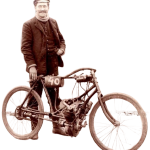
Komet motorcycles were produced between 1902 and 1905 in Dresden by the Kirschner & Co Fahrradwerke, later reorganised as Komet Fahrradwerke A.G. The company was one of the first producers of two-stroke motorcycles in Germany. That Kirschner had already established itself as a respected bicycle manufacturer under the Komet name before venturing into powered machines gave the firm a solid platform from which to take its motorised leap.
The key to the Komet’s engineering lay in a French patent. The engines were built under licence from the French Ixion design, conceived in 1901 in Lille by Léon Cordonnier. This lightweight engine was fitted to a bicycle as an auxiliary unit, with the engine driving the front wheel via a rubber friction wheel that was actually part of the flywheel. The complete powerplant could be raised and lowered by a lever system, allowing the rider to disengage drive when needed. The licence arrangement placed Komet in notable company, as the same Cordonnier design inspired concurrent licensed builds in Britain by the Primus Motor Works of London, demonstrating just how widely the Ixion concept circulated in the pioneering years.
The fuel tank incorporated a surface carburettor to manage the mixture, a compartment housed the battery and high-tension coil ignition, and a drip-feed oiler supplied lubrication to the engine. These were the essential ingredients of early motorised cycling stripped to their minimum: no clutch, no gearbox, no pretence at being anything more than a pedal bicycle with a buzzing auxiliary motor hanging from its frame.
The range evolved during the firm’s short life. Engines fitted ranged in output from 1 to 4 hp, with the smallest machines remaining true motorised bicycles and the more powerful variants edging toward what contemporaries were beginning to call motorcycles in their own right. The Cordonnier-derived two-stroke at the entry level displaced around 100cc and produced approximately 1 hp, while the upper end of the range, at 4 hp, would have required an entirely more substantial machine beneath it.
Dresden in 1902 was a city of genuine industrial ambition, and Komet sat alongside other Saxon manufacturers pressing into the new world of motor transport. The firm’s relatively swift transition from Kirschner & Co to a fully reconstituted Aktiengesellschaft suggests that motorised vehicles were taken seriously as a business proposition rather than as a sideline to the bicycle trade. That the venture lasted only three years reflects not any particular failure of the product but the brutal attrition of the early German motorcycle market, where the annual output of machines was divided between a great many builders, most of whom purchased their engines in France or Belgium, or copied the more successful foreign designs. Komet at least had the distinction of manufacturing its French-derived engines under formal licence, a mark of commercial seriousness in an era when such niceties were rarely observed.