KLOTZ | 1923-26 | Germany :
The Klotz is one of those German motorcycle marques whose historical significance lies less in its own brief commercial life than in the man whose career it launched. Behind the 150 or so machines built at the Bahnhofstrasse factory in Stuttgart stands the engineering apprenticeship of Wilhelm Gutbrod, whose work for Klotz was the direct foundation for the Standard marque that followed.
After the war, Wilhelm Gutbrod graduated from the Esslingen Institute of Technology, where he presented a light two-stroke engine motorcycle as a graduation project. At first he was working in Kaelble, a company manufacturing road-rollers. He then managed to meet Eugen Klotz, a manufacturer interested in his motorcycle project.
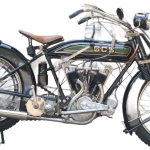
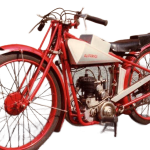
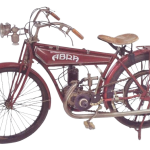
The motorcycles were manufactured by Maschinenfabrik Eugen Klotz in Stuttgart, Bahnhofstrasse 129, from 1923 to 1926, under the direction of G. Roau. They were 246cc two-strokes designed by Wilhelm Gutbrod, who later founded the Standard brand, making Klotz the immediate predecessor of Standard motorcycles. Ridden by Gebbardt and others, the marque was quite successful in competition.
All Gutbrod’s bikes from 1923 to 1926 were manufactured under the Klotz marque. These machines proved their quality through sporting achievements, but as for the market of cheap bikes, they could hardly beat the machines made by motorcycle giants like DKW. This was the central difficulty facing the Klotz. The German lightweight two-stroke market of the early and mid-1920s was being defined by DKW of Zschopau, whose enormous production volumes and continuously developing engines set price points that small-batch producers in Stuttgart workshops could not match commercially, whatever their technical merits on the competition circuit.
The Bahnhofstrasse factory produced a total of around 150 motorcycles. There are probably seven of the Klotz motorcycles extant. The firm also built small trucks with one to one and a half tonne load capacity.
The ending of motorcycle production at Klotz was not the ending of Gutbrod’s ambition. When Klotz decided to quit motorcycle manufacturing, Wilhelm Gutbrod and Gustav Rau, the sales manager at the Maschinenfabrik owned by Eugen Klotz, founded their own motorcycle company named Standard Fahrzeugfabrik. In the beginning the company occupied abandoned military stables on the outskirts of Ludwigsburg. Gutbrod set high quality levels for his Standard motorcycles. They were built along British lines and used British proprietary parts such as Burman gearboxes and Castle forks. At first 248cc and 348cc OHV JAP engines were built in but Gutbrod soon switched to Swiss MAG power sources available in 350, 500, 750 and 1000cc capacities. Due to the quality and workmanship of the machines, Standards were very successful in racing and durability trials.
Gutbrod was a German manufacturer of cars, motorcycles and small agricultural machinery. The firm originally built Standard branded motorcycles. In 1933 the company relocated to the nearby Stuttgart suburb of Feuerbach, and from 1933 to 1935 Standard Superior cars were built with rear-mounted engines. The Gutbrod Superior car introduced in the early 1950s was the first car in the world to be offered with fuel injection, a landmark in automotive engineering that traced a direct line back to the 150 two-stroke motorcycles assembled in a Stuttgart machine factory between 1923 and 1926.