KATAKURA | 1950s-1980s | Japan :
Katakura Industries launched its silk manufacturing operations in 1873 and contributed to the modernisation of Japanese industry through silk. The company began producing bicycles after the war in a factory near Yokota, in western Tokyo, which had previously produced aircraft parts. The Silk brand name dates from 1954, deriving from the silk factory the bicycle manufacturing company later occupied.
The first Silk bicycle was built for Keirin racing, the form of motor-paced cycle racing developed in Japan around 1948 for gambling purposes, in which track cyclists sprint for victory following a speed-controlled start behind a motorised pacer. Post-war Japan lacked experienced constructors capable of making competitive track racers, so the Katakura Silk racer for the Olympics was developed using craft methods after many trials and errors.
The Japanese road cycling team used Silk bicycles from Katakura Industries at the 1964 Tokyo Olympics, proving to the world that Japan could produce superb sports bicycles. The team acknowledged that the Silk’s excellence helped them achieve outstanding results, instantly boosting its popularity. This was a shining moment in the golden era of Japan’s cycling history, during which many domestic manufacturers vied to produce the best bicycle.
The racing-style Silk bikes were highly regarded by Keirin racers and were produced alongside custom French touring-style bikes, a versatility that made the company comparable in range to Raleigh of England, covering professional racing bikes through to children’s bicycles.
In the 1970s and 1980s Katakura ran mass production of Silk sports bikes, mainly for the Japanese domestic market, with some export. The folding Porta-Cycle also formed part of the range. The Porta-Cycle design was acquired from automotive engineer Norishige Yokomaki, who had created it for his personal use in 1951, and it was patented in the USA in 1957.
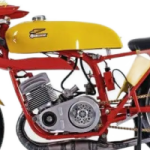
Separately from the Silk bicycle range, Katakura was active as a motorcycle manufacturer from the late 1950s through the late 1960s, specialising in two-stroke powered vehicles including mofas, mopeds, and lightweight motorcycles. Products spanned engine displacements from 48cc to 248cc, covering small urban runabouts to more capable mid-range machines, with a focus on affordable mobility, ease of maintenance, and fuel economy during Japan’s rapid urbanisation and economic recovery.
The Silk brand was a victim of the rampant yen in the 1980s and did not survive the 1990s. When Katakura Industries eventually began to shut down its bicycle production line, former employee Tadashi Arai personally bought much of the unwanted machinery, stockpiled it in a warehouse in Saitama, and eventually revived the Silk name through his own Silk Bicycle Factory, which he established in 2005.