KAPTEIN | 1922-70s | Netherlands :
Kaptein was founded by Willem Kaptein in 1922 as a bicycle repair shop. By 1925 he was an importer of Ariel and later dealt in Calthorpe, Imperia, Puch, Norton, Husqvarna, TWN and possibly others. The address recorded for the early dealership was Stadhouderskade 142–143 in Amsterdam
The range of marques Kaptein handled was eclectic and deliberately broad — British sports machines (Ariel, Calthorpe, Norton), Austrian lightweights (Puch), German two-strokes (TWN), and Swedish machines (Husqvarna) — covering different price points and purposes.
The French Motobécane motorcycle was imported in 1938 and 1939 by Willem Kaptein. Kaptein took over the import licence for Motobécane in 1938 and met considerable if brief success before WW2. The German occupation of the Netherlands from May 1940 disrupted all normal commercial activity, eliminated motorcycle imports from non-German-aligned sources, and placed civilian motoring under severe restrictions. The Motobécane import business, barely established, was suspended for the duration of the war.
The liberation of the Netherlands in May 1945 left the country with severe infrastructure damage, depleted industry, and a pressing need for affordable personal transportation. It also left Willem Kaptein facing a different commercial landscape from the one he had known before the war. Import tariffs on motorcycles had been sharply increased to protect the balance of payments and encourage domestic industry. Post-war, it turned out that producing engines was cheaper than importing them because of the high import duties.
In August 1948 Willem Kaptein formally constituted N.V. Kaptein and had a factory built at the Nieuwe Kade in Arnhem on the site of the former electricity generating station, which was opened on 27 April 1949 by Mayor Matser. The choice of site was practical necessity as much as commercial vision: this was an old power station that had been partly destroyed in the war and was scheduled for demolition. The ruins were quickly rebuilt and made ready for motorcycle manufacture. Arnhem itself was one of the most heavily damaged Dutch cities — the site of the catastrophic Allied airborne operation of September 1944 — and the use of a bombed-out industrial building for a new peacetime enterprise was characteristic of the Dutch post-war spirit of practical reconstruction. Motobécane took a 49 per cent stake in N.V. Kaptein as part of the arrangement.
The factory would initially assemble machines from French-supplied engine blocks and components, with the intention of progressively increasing domestic manufacture.
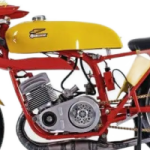
Kaptein established a factory in a ruined power station in Arnhem where he built 125cc and 175cc machines with SV and OHV engines of his own manufacture, under licence from Motobécane. The motorcycles were closely based on the Z2c and D45A. Initially Motobécane supplied engine blocks and other components, but Kaptein soon made everything itself. The first machines were 125cc side-valve and 175cc overhead-valve units. The two models offered quite different propositions to the Dutch buyer. The D45A machine had a 125cc side-valve engine with a three-speed transmission and a top speed of 65 km/h. It had a parallelogram front fork and a rigid rear end, priced at 1,020 guilders. The other motorcycle was almost identical to the Motobécane Z2c and was much more modern. It had a 175cc overhead-valve engine, a four-speed gearbox with foot shift, telescopic front forks and plunger rear suspension. The top speed was 95 km/h and it was priced at 1,475 guilders. The 175cc OHV was genuinely competitive with its contemporaries on paper, offering telescopic forks and rear suspension at a time when many European lightweights still used girder forks and rigid frames.
The problem was that the machine had serious teething troubles and the high investment required for improvement caused Kaptein to decide in 1951 to cease motorcycle production. There were only 800 motorcycles built in total; most were of the Z2c type — the overhead-valve — with a capacity of 175cc, and the rest were of the B45 type — the side-valve — with 125cc. Production was hoped to be as high as 50 units per day, around 12,000 per year. Competition from other manufacturers put paid to these expectations, and production ceased in 1951 after about 800 were built. The combination of quality problems with the 175cc model, the cost of rectifying them, and the fierce competition from established makers — both domestic and, once tariffs began to ease, imported — made continuation untenable
While the motorcycle venture was ending in commercial disappointment, a more significant project was already under way. Willem Kaptein’s relationship with Motobécane had given him direct insight into the French manufacturer’s product development, and he had been pressing his French partners to address a specific mechanical weakness. Kaptein had strongly urged the strengthening of the frame of the Motobécane Poney, which ultimately led to the development of the highly successful Mobylette moped — a Motobécane product that would also be built under licence in Spain, Iran, Zaïre and Morocco. For Mr Benoît of Motobécane, the Poney had been a failed experiment. The frame was too weak. For the Dutch market, however, visitors saw possibilities, and the idea was immediately put forward to make a special frame for it. The Kaptein-Motobécane collaboration thus produced one of the most commercially successful mopeds in history. Motobécane introduced the Mobylette in 1949; over the next 48 years Motobécane manufactured 14 million Mobylettes, with peak production in the 1970s averaging around 750,000 annually
The motor press of the time described the Mobylette as follows: “This Kaptein has a little engine of 50cc in a frame specially made for this purpose. The two-stroke engine is capable of propelling the bicycle at a speed of 30 km/h, and that the little engine does this without effort is evident from the low speed of 2,800 revolutions per minute.” The word bromfiets — which became the standard Dutch term for a moped — was coined around this time, reportedly by a journalist of the newspaper Het Parool in 1950, specifically in connection with the new class of machine that the Kaptein-Mobylette represented. Factory growth and the Mobylette boom In January 1950 the first mopeds came off the assembly line at the Nieuwe Kade factory: 123 units. By the end of 1950 the factory was producing around 2,000 mopeds per month. This was an extraordinary rate of growth for a factory that had only opened its doors the previous April. The Nieuwe Kade site quickly proved inadequate. The company had grown to around 400 employees by 1953. By March 1954 N.V. Kaptein moved to a new factory at the Dr C. Lelyweg in Arnhem, festively opened on 31 May 1954 by Mayor Matser. At that point around 80,000 Mobylettes were in use in the Netherlands, out of a total of approximately 283,000 mopeds registered. Export went primarily to Belgium, France, Suriname, Indonesia, New Guinea and British East Africa, where the Mobylettes were much sought after for their robustness.
In 1965 production of Mobylettes moved to a sister factory in France, because it was cheaper there. In 1966 Kaptein merged with Union. In 1966 they celebrated the production of 1,000,000 bicycles and that year merged with Motorenfabriek Kaptein NV under the name Unikap, and the Union brand was sidelined in favour of Kaptein Mobylette mopeds built in France. In 1965 the collaboration with the Rijwiel- en Bromfietsfabriek Union led to the formation of Rijwiel- en Motorindustrie Unikap N.V. The collaboration was dissolved in 1973, although Union continued to use the Unikap name until 1984. From then until circa 1973 all of their mopeds were imported from France and rebadged. The Kaptein name continued in commerce even after the manufacturing ceased, attached to French-built Mobylettes, until the final dissolution of the partnership.
The headline fact of Kaptein’s history is that it built only 800 motorcycles across three years of manufacturing — a modest output by any measure. Its lasting significance lies elsewhere entirely: in the commercial and engineering pressure that Willem Kaptein applied to Motobécane to strengthen the frame of their lightweight prototype, which produced one of the most widely sold mopeds in history. Around 80,000 Mobylettes were on Dutch roads alone by 1954, and the global total would reach 14 million over five decades. That a cycle dealer from Arnhem, operating in a converted wartime ruin, contributed to that outcome is one of the more improbable stories in post-war European motorcycling.