KANE-PENNINGTON | 1895 | USA :
The Kane-Pennington motorcycle was produced in 1895 as a result of a partnership between Edward Joel Pennington and Thomas Kane in Racine, Wisconsin.
Pennington, who coined the term ‘motorcycle,’ designed the vehicle, which featured a patented ‘long-mingling spark ignition system’ that allowed it to run on various fuels.
Edward Joel Pennington (1858, Moores Hill, Indiana — 1911, Springfield, Massachusetts) was an inventor and promoter of many mechanical devices, including airships, motorcycles, and automobiles. He often promoted his inventions with grandiose and spurious claims, which would become a hallmark of his entrepreneurial schemes. Frequently he collected financial backing for his business ventures, but rarely did his investors ever collect any dividends from his projects. He was regarded by many as a fraud on account of his unproven claims and business practices, yet he never spent any time in prison. Pennington was not, however, simply a charlatan. He was a man of genuine mechanical curiosity and ingenuity, capable of producing physical objects — engines, vehicles, patents — even if those objects rarely performed as claimed. In addition to motor vehicles, he applied for and received patents for Stirling engines, ignition systems, planing machines, and pulleys. He had, as one contemporary source noted, remarkable engineering aptitude from boyhood, combined with an equally remarkable gift for charm, persuasion, and the creation of elaborate illusions of success.
In 1890 Pennington built the first engine of the design that was later known as the Kane-Pennington. In 1895 he built and demonstrated his original motorcycle design in Milwaukee, where he attracted the attention of Thomas Kane, an established manufacturer who acquired the patents. In 1894, E.J. Pennington joined with Thomas Kane in Racine, Wisconsin, to build Kane-Pennington engines and motorcycles. The company actually produced very little — a few engines, a couple of powered bicycles and a four-wheeled carriage, all of which were unsatisfactory. Thomas Kane’s company was a real manufacturing concern with genuine production capability, and the Kane-Pennington name represented a genuine collaboration rather than simply a promotional exercise. Kane brought manufacturing credibility; Pennington brought the patents and the concepts. The Kane part of the name came first alphabetically and commercially, though in the history of self-promotion it was always Pennington who dominated the story.
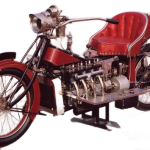
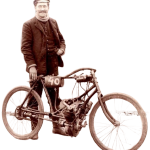
The Kane-Pennington motorcycle was a genuinely unconventional design for its era, standing apart from the contemporaneous European approach of fitting clip-on engines to conventional bicycle frames. The Kane-Pennington had a two-cylinder engine mounted behind the rear wheel. The rear wheel was the crankshaft, and the connecting rods went to both sides of the wheel. Due to its direct drive and high gearing, the Kane-Pennington could push the rider to 50mph. The cylinders were extraordinary by any standard. Pennington constructed what was described as a “singularly crude ‘moto-cycle'” featuring unusually long drainpipe cylinders without any cooling mechanism, a drip fuel feed in place of a conventional carburettor, and the enigmatic ‘long-mingling spark’ ignition system.
Where virtually every engine designer of the period was grappling with the problem of heat dissipation — adding fins, water jackets, and ventilation — Pennington simply omitted cooling entirely. The cylinders were plain tubes with no fins whatsoever, relying on what Pennington claimed was the cooling effect of the long-mingling spark itself to prevent overheating. The engines had two cylinders with no fins and direct drive. Low-tension ignition provided what was claimed to be a ‘long-mingling spark’.
On test, the machine was reported to have a speed range of 8mph to 48mph. Ignition usually failed, but if the machine did go successfully, it could run for 10 miles/16km — even though the cooling was so poor. Notable features were that the engine’s cranks were connected directly to the rear axle, the cylinders had no cooling fins, and Pennington made use of balloon tyres — an invention he is also often credited with. The long-mingling spark: Pennington’s central claim The ‘long-mingling spark’ was the centrepiece of Pennington’s technical mythology and the justification for every seemingly impossible claim he made about the machine’s performance. The concept was a low-tension ignition system that he claimed produced a slow, persistent electrical discharge that allowed complete combustion even of very low-grade fuels. The ingenious Pennington claimed that, thanks to the ‘long-mingling spark’, the engine would run on ordinary paraffin, and purported to prove the fact by testing the fuel with a densimeter. But he didn’t use paraffin, and instead used the very best, most volatile petroleum, and a densimeter with faked graduations.
The fuel versatility claim was connected to another claimed benefit: that the long-mingling spark so thoroughly consumed the fuel charge that engine temperatures were kept low, eliminating the need for cooling fins. This elegantly circular argument — no cooling fins needed because the special spark prevents overheating; the special spark allows any fuel because it ensures complete combustion — was characteristic of Pennington’s method. Each spurious claim justified another, creating a self-referential system of impossible promises. The actual ignition system did exist and did function after a fashion.
Pennington coined the word “motorcycle”, built the first gasoline powered machine on roads in both the USA and England, and was the first to use spark ignition in the form of his peculiar “long mingling spark” system. It works — I have one, wrote one later constructor who built a working replica, confirming that the basic ignition concept had some mechanical reality even if its performance claims were fantastical.
Pennington was a master of the carefully staged demonstration. His most audacious promotional claim was that his motorcycle could jump a wide river — a crude, rear-engined motorcycle with a direct drive that Pennington advertised by showing it jumping over a river, like some late Victorian, 1¼hp Evel Knievel. Advertisements showed the machine vaulting impossible distances, attracting astonished attention and investment in equal measure. He also claimed speeds of up to 65mph — in an era when 20mph was considered remarkable for a self-propelled vehicle — and claimed his tyres were impossible to puncture. His ‘impossible to puncture’ pneumatic tyres proved exactly the opposite and went flat.
Pennington had made a show of wealth and prosperity using a private railroad car and the trappings of success to dupe investors into buying stock in his companies. He used shady tactics such as having telegrams sent to him by his own assistants falsely bearing the names of the rich and famous such as the Rockefellers, asking to buy stock, to persuade investors he was a sure success when he was, in fact, a failure. The 1895 Chicago Times-Herald Race: a public failure The moment when the Kane-Pennington’s gap between claim and reality became unavoidably public came at the first automobile race ever held on American soil.
The Chicago Times-Herald race was held in Chicago in 1895 among six motorised vehicles. It was won by Frank Duryea’s Motorized Wagon. His entry in the November 1895 Chicago Times-Herald Race (80 entrants, of which he was one) was hopeless. The vehicle was there but it could not compete. The vehicle was “given short runs at Chicago, but never came to the starting line,” as Charles B. King reported in the December 1895 issue of The Motorcycle magazine. The race failure was the beginning of the end of Kane-Pennington’s American credibility. The failure of the Kane-Pennington sales and the 1895 race failure were not what his investors were waiting for, and with his motorised bike in tow and evading his creditors, he left for Great Britain.
One lasting contribution of genuine historical interest emerges from Pennington’s career. He is sometimes credited with having invented the word “motorcycle”; he used the term as early as 1893. The Chicago Times-Herald itself contributed to the terminology — the editors could not easily agree upon a name for motor vehicles. After considerable wrangling, the editors decided to call it a Moto Cycle race and first used the term in a July 15 article. The coinage of the word — whether primarily Pennington’s or the Times-Herald’s — reflects the genuine novelty and namelessness of the machines being created in the mid-1890s.
Pennington’s flight to Britain was not a retreat into obscurity but a move to a larger and richer stage. These advertisements, along with some unlikely prototypes like a propeller-driven bicycle displayed at the 1896 National Cycle Show, helped Pennington persuade Lawson to purchase the British rights to his patents for a staggering £100,000 — £90,000 of which was paid in cash. Harry John Lawson was the great patent-gatherer of the early British motor industry, attempting to acquire control of every significant motoring patent and collect royalties from manufacturers. He was an ideal mark for Pennington. The English rights to the Kane-Pennington motor vehicles and engine were licensed by Harry Lawson; two machines were built by the Humber firm in Coventry; there was a lot of advertising and many extravagant claims.
The Great Horseless Carriage Company did produce five Pennington autocars, the rights to which had been purchased from Kane-Pennington at a vast price reportedly £100,000. The Autocar reported in June 1896: “…although the motor required some little alteration, the speed developed was said to have varied from thirty to forty miles per hour.” The only surviving example of the Pennington design is preserved by the National Motor Museum in Beaulieu, Hampshire, England. The Lawson transaction was spectacular even by the standards of the era’s promotional excess. The £100,000 purchase price — for patents whose underlying machines could not reliably travel 10 miles — was the single largest transaction in the early British motor industry, representing perhaps the greatest triumph of Pennington’s promotional genius over commercial and technical reality.
Edward Joel Pennington died in 1911, having married three times and received 27 US patents, leaving behind a trail of defrauded investors, unfulfilled promises, and at least one surviving vehicle — preserved now in Beaulieu — as physical evidence that the machines, however dysfunctional, actually existed. The Kane-Pennington stands at a genuinely important moment in the history of motorcycling. Its direct-drive twin-cylinder rear-mounted engine layout, its long drainpipe cylinders, its low-tension ignition, and its balloon tyres were all genuine technical departures from the contemporaneous European norm. The fact that they didn’t work reliably, or at all in many cases, does not erase their historical position as one of the earliest purpose-designed motor bicycles in the United States, built at the very moment when the concept of the motorcycle was still so new that the English language lacked an agreed word for it. The Kane-Pennington’s most enduring legacy may be the word itself — motorcycle — that Pennington helped bring into circulation, even as he exited Racine one step ahead of his creditors.