A & A AUTOCARRIER | 1904-13 | UK :
The story of Autocars and Accessories Ltd begins not with the company itself but with its two founders, and with the failure of a rather more ambitious project than a delivery tricycle. John Weller was a south London engineer, the son of a bookseller, born in Peckham in 1877 and raised in West Norwood. By 1900 or 1901 he had established a small workshop in that suburb with his elder brother Harry, trading as Weller Brothers and making their living repairing and servicing the emerging generation of motor cars and motorcycles, with a particular specialism in De Dion-Bouton machines. John Portwine was a different sort of man entirely — a prosperous local butcher who ran a chain of shops trading as the London and Suburban Meat Stores, with at least eight branches scattered across south London. Portwine was neither engineer nor mechanic but he was entrepreneurial, commercially acute, and fascinated by the motor vehicle as a business prospect. The two men shared a neighbourhood, and in 1902 Portwine joined the Weller partnership as financial backer.
Their first shared ambition was large. John Weller designed an advanced 20-horsepower four-cylinder touring car and exhibited it at the Crystal Palace Motor Show in January 1903 to considerable critical enthusiasm. The Autocar magazine declared it had a brilliant future. But enthusiasm from the press was not the same thing as a viable business, and the costs of bringing so sophisticated a vehicle into series production proved beyond the partnership’s means. Only a single car was completed. It was Portwine who drew the necessary commercial conclusion: rather than pursuing a luxury vehicle for which capital was insufficient and the market uncertain, they should concentrate on something simpler, cheaper to build, and with an obvious commercial application. He proposed a small three-wheeled delivery vehicle — practical, affordable, and aimed squarely at the urban trades he knew from his own business.
Weller executed the brief with characteristic technical care. The resulting machine, which they called the Auto-Carrier, was a tricar-type three-wheeler of deceptively simple construction: two wheels at the front straddled an open cargo box, with the driver seated behind, above a rear-mounted air-cooled single-cylinder engine of around 5 to 6 horsepower. Drive was transmitted by chain to the single rear wheel through a two-speed epicyclic gearbox. Steering was by hinged tiller. The main frame was built of ash reinforced by birch panels, a construction method that made it both light and robust, with a tubular steel sub-frame carrying the engine. A two-and-a-quarter-gallon petrol tank gave the driver a working range of 75 to 100 miles — perfectly adequate for urban delivery rounds. The engineering, as on all Weller’s work, was done to a high standard: the vehicle was built to be reliable and to keep earning its keep.
To manufacture and market it, a new limited company was incorporated in early 1904: Autocars and Accessories Ltd, abbreviated almost immediately to A & A. Its first registered address was 114 Long Acre, a central London street with a long history of coachbuilding and motor trade premises. Portwine and John Weller were the principal directors. Harry Weller, who had been part of the original workshop from the beginning, was also involved in the business, though his precise role in the new company is less clearly documented than his brother’s. Weller Brothers itself was wound up and sold in the course of 1904 and 1905 — its premises in West Norwood were taken over by another local operator — and production of the Auto-Carrier began the same year.
The vehicle was an immediate commercial success. Long Acre was soon left behind and the operation relocated to West Norwood, built at two adjacent workshop sites on Thomas Place and at 158a Norwood Road, less than a hundred yards apart in the suburb where John Weller had grown up and where both founders had their local connections. The Weller family lived nearby on Idmiston Road; Portwine’s shops were part of the local commercial fabric; the move made personal and practical sense. The early months of the Long Acre operation had also included selling Minerva motor cars — the Belgian manufacturer whose engines had been a staple of the early British motor trade — but this agency was lost by the end of 1904, removing one reason to remain in the West End.
The Auto-Carrier found buyers rapidly and from an impressive range of businesses. London’s large stores and commercial enterprises recognised it as an economical solution to urban delivery, competitive with horse-drawn vans on narrow streets and far cheaper to run. Boots, Maples, United Yeast and the Aerated Bread Company were among the reported customers. Goodyear is said to have operated a fleet of nearly a hundred Auto-Carriers for tyre delivery. The vehicle was also adaptable: John Portwine himself competed with one in motor sport, and the basic design proved amenable to military modification as a troop and machine-gun carrier. Photographs survive of Auto-Carriers in Australia, taken around 1905 and belonging to the Brisbane department store Finney Isles & Co., indicating early export reach within the British Empire.
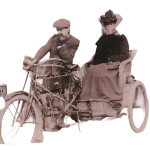
By 1907 — by which time the company had formally renamed itself Autocarriers Ltd to reflect its now singular focus — the success of the commercial carrier justified an extension of the range. A passenger variant appeared, initially placing the passenger in the cargo space directly ahead of the driver and subsequently modified so that driver and passenger could sit side by side, with a three-seater option also offered at a small premium. This variant acquired first the name Tricar and then the name Sociable, and it was on this passenger version, in 1907, that the abbreviation A.C. was used for the first time. By 1912 it was being described in the trade press as one of the most popular cycle cars on the road. An advertisement of the period marketed it as the Mighty Atom, and a photograph from 1911 shows one making the journey from London to Edinburgh. Even the Sociable, improbable as it looked, was raced at Brooklands.
The early years of the company were also complicated by John Weller’s parallel involvement in another venture. Shortly before or around the time A & A was being established, he had taken a position as engineer and co-designer at the Hitchon Gear and Automobile Company in Accrington, Lancashire, a firm run by Alfred Hitchon that produced a small number of cars under the Globe and Hitchon-Weller names between 1904 and 1907. This engagement proved short-lived — the two ventures were difficult to reconcile, and Weller ultimately returned his full attention to the West Norwood concern. The Hitchon connection is nonetheless significant for AC’s later engineering: the worm-shaft rear axle that Weller helped develop there reappeared in AC models for years afterwards.
By 1909 the company had also taken on additional premises at 42a Martell Road, about half a mile from the main Thomas Place and Norwood Road sites, suggesting the original workshops were working to capacity. Production was outgrowing West Norwood altogether. In September 1911, at an Extraordinary General Meeting of the shareholders, the decision was taken to move the entire operation to a former Victorian engineering works at Thames Ditton in Surrey — the Ferry Works, previously occupied by the steam-engine makers Willans and Robinson, where a young Archibald Frazer Nash had served part of his engineering apprenticeship. The company was simultaneously reconstituted as a new limited company, Auto Carriers (1911) Ltd, with the old entity wound up as a legal formality. At this point the famed AC roundel logo was adopted.
By 1913, the date at which A & A’s direct story conventionally ends, the company’s ambitions had expanded beyond the three-wheeler. A four-wheeled light car powered by a Fivet four-cylinder engine was in production — modest and fragile by later standards but a genuine step towards the passenger car market. Weller and Portwine continued together until 1922, when the racing motorist and businessman Selwyn Edge acquired control and both founders resigned. The firm would go on as AC Cars Ltd, producing the celebrated six-cylinder Weller-engined sports and touring cars of the 1920s, the Ace and the Cobra. But the seed of all that was a butcher’s practical suggestion to an engineer in West Norwood, and the simple three-wheeled delivery vehicle that resulted.