Smoke plume from Northcliffe bushfire, Western Australia

A BUSHFIRE burning in Western Australia’s South-West,  in bushland south-east of Northcliffe, 365km south of Perth, is responsible for a smoke haze which blanketed Perth.
The satellite image shows a huge plume of smoke from the fire extending up the coast and into Perth. The fire, started by a lightning strike is burning fiercely in , about 13km south-east of Northcliffe. The bushfire is burning in a mixture of coastal heath and tall Karri Forest with high fuel loads that have potential to burn with very high intensity.  The fire has burnt through approximately 16,000ha with an estimated final containment area of 30,660ha. Source: Perth Now

New element discovered

New element discovered

The CSIRO has discovered the heaviest element yet known to science.

The new element is Governmentium (Gv). It has one neutron, 25 assistant neutrons, 88 deputy neutrons and 198 assistant deputy neutrons, giving it an atomic mass of 312.

These 312 particles are held together by forces called morons, which are surrounded by vast quantities of lefton-like particles called peons.

Since Governmentium has no electrons or protons, it is inert. However, it can be detected, because it impedes every reaction with which it comes into contact. A tiny amount of Governmentium can cause a reaction normally taking less than a second to take from four days to four years to complete.

Governmentium has a normal half-life of 2- 6 years. It does not decay but instead undergoes a reorganisation in which a portion of the assistant neutrons and deputy neutrons exchange places.

In fact, Governmentium’s mass will actually increase over time, since each reorganisation will cause more morons to become neutrons, forming isodopes.

This characteristic of moron promotion leads some scientists to believe that Governmentium is formed whenever morons reach a critical concentration. This hypothetical quantity is referred to as critical morass.

When catalysed with money, Governmentium becomes Administratium, an element that radiates just as much energy as Governmentium since it has half as many peons but twice as many morons. All of the money is consumed in the exchange, and no other byproducts are produced.

LBJ reveals GI Mutiny and more on MacArthur’s Hubris

The newspapers are full of a story about a mutiny by African-American GIs in WW2 at Townsville, Queensland, Australia. Apparently the story was covered up at the time. Couldn’t have been as big as the news story would have it as casualties were remarkably low when you consider 700 rounds were fired. Here are the details…….


An Australian historian has uncovered hidden documents which reveal that African American troops used machine guns to attack their white officers in a siege on a US base in north Queensland in 1942.

Information about the Townsville mutiny has never been released to the public. [Blog Ed. that is questionable!]

But the story began to come to light when James Cook University’s Ray Holyoak first began researching why US congressman Lyndon B Johnson visited Townsville for three days back in 1942.

What he discovered was evidence detailing one of the biggest uprisings within the US military.

“For 70 years there’s been a rumour in Townsville that there was a mutiny among African-American servicemen. In the last year and a half I’ve found the primary documentation evidence that that did occur in 1942.”

During World War II, Townsville was a crucial base for campaigns into the Pacific, including the Battle of the Coral Sea.

About 600 African-American troops were brought to the city to help build airfields.

Mr Holyoak says these troops, from the 96th Battalion, US Army Corps of Engineers, were stationed at a base on the city’s western outskirts known as Kelso.

This was the site for a large-scale siege lasting eight hours, which was sparked by racial taunts and violence.

“After some serial abuse by two white US officers, there was several ringleaders and they decided to machine gun the tents of the white officers,” Mr Holyoak said.

He has uncovered several documents hidden in the archives of the Queensland Police and Townsville Brigade detailing what happened that night.

According to the findings, the soldiers took to the machine guns and anti-aircraft weapons and fired into tents where their white counterparts were drinking.

More than 700 rounds were fired.

At least one person was killed and dozens severely injured, and Australian troops were called in to roadblock the rioters.

Mr Holyoak also discovered a report written by Robert Sherrod, a US journalist who was embedded with the troops.

It never made it to the press, but was handed to Lyndon B Johnson at a Townsville hotel and eventually filed away into the National Archives and Records Administration.

“I think at the time, it was certainly suppressed. Both the Australian and the US government would not have wanted the details of this coming out. The racial policies at the time really discluded [sic] people of colour,” Mr Holyoak says.

Both the Australian Defence Department and the Australian War Memorial say it could take months to research the incident, and say they have no details readily available for public release.

But Townsville historian Dr Dorothy Gibson-Wilde says the findings validate 70-year-old rumours.

“Anytime it was raised, people usually sort of said, ‘Oh you know, no that can’t be true. Nobody’s heard about that’, and in fact it must have been kept pretty quiet from the rest of the town,” she said.

Mr Holyoak will spend the next two years researching the sentences handed out to both the officers and the mutineers involved, and why the information has been kept secret for so long.

Source: abc.net.au

Company "A", 96th Engineers in Port Moresby on 19 November 1943

This made out to be big news but website www.ozatwar.com has had a write-up on this event on it’s site for some time, as follows:

By August 1942, there were about 7, 258 Negro servicemen based in Australia. One such Negro unit was the 96th Engineers General Services Regiment airfield construction Battalion that was based in the Upper Ross area near Townsville to construct the Upper Ross airfield (Kelso field).

On 15 April 1942, about 100 men of the 96th Battalion were involved in a fight in Townsville. They had been rounded up by white soldiers with fixed bayonets and loaded guns.

On 22 May 1942 between 8 pm and 9 pm several shots could be heard coming from the Negroes camp. One of the many to hear the shots was the late Arthur Kelso who was riding his horse on his property at Laudham Park, on Five Head Creek in the Upper Ross area just outside Townsville. He heard the initial shots and judged them to be about 1.5 miles away. The shooting continued and he could then hear Thompson sub machine guns. The firing continued until about 11pm.

Many of the locals who heard the firing thought the military were playing “war games”. However all hell had broken loose at the camp. One source suggested that the riot started when a white Captain struck a Negro soldier. Arthur Kelso indicated that drunken Negroes started to fire guns at their white officers, who then returned the fire.

A road block was set up to prevent the rioting Negroes from entering Townsville. There were reports of 250 Negroes on the rampage and that they had commandeered some trucks and were heading into town. Arthur Kelso reported that he later heard that 19 coffins had been ordered to bury those killed in the riot.

Dick Kelso, Arthur’s brother, who was with the 11th Brigade was one of those who manned a road block on Ross River road that evening after the riot. Dick said they were issued with live ammunition and Bren Guns as well. Dick reported that the rioting Negroes had been stopped and turned back at another road block near Corbeth’s water hole on Ross River.

Another report on www.politicalhotwire.com highlights:

Armed Australian troops were sent in at the height of the emergency on the US base.

George Gnezdiloff, then a 20-year-old private in the north Queensland-raised 51st battalion, was told to block Ross River Road with his bren gun carrier. Other soldiers were issued with a password, Bucks, as they deployed to bottle up the Americans.

Gnezdiloff and his crew were ordered to shoot the mutineers on sight. “We had ammo, the lot,” the now 90-year-old recalled yesterday from his home in Proserpine, 300km south of Townsville.

“We weren’t mucking around, I can tell you.”

The disgruntled African-Americans were from the US 96th engineers, a labour battalion that had the thankless job of building the airfields and barracks around Townsville. Racial tensions had been simmering for months, creating a poisonous atmosphere on the base at Kelso Field, southwest of the city. On the night of May 22-23, 1942, it boiled over. The men of A and C companies took up arms against their white officers, angry at claims a black sergeant had died at the hands of a white superior.

Sherrod’s report says the mutineers resolved to kill their commander, Captain Francis Williams, of Columbus, Georgia. “They fired several hundred rounds at his tent,” it says.

After Williams escaped “almost certain death” by diving into a slit trench, the rebels turned a machine gun on other officers as they fled. There is no record of whether any were hit.

The mutinous A and C companies of black engineers were hurriedly packed off to New Guinea, where the Australians of the 51st Battalion were also bound, to confront the Japanese.


More than 10,000 African-American servicemen were put to work in north Queensland during the war, and Holyoak says the racial violence at Kelso was not isolated. Other clashes between white and black US personnel took place at Torrens Creek, Ingham and Mt Isa in 1942.

The researcher believes Roosevelt was aware of the tensions, and this may have been a factor behind the visit of his wife, Eleanor, to Townsville in 1943, when the then first lady dropped in on the newly established North American Services Club in Flinders Street – a “negro-only” establishment.

The best part is the report made by Lyndon Johnson, see attached paper.

This report also contains comments on MacArthur…and his super-size ego. Interesting reading.

See also…..MacArthur’s Hubris

The 39th Battalion Australian Imperial Force (AIF)

The 39th Battalion was an infantry unit of the Australian Army. It was originally raised in February 1916 for service during World War I as part of First Australian Imperial Force. Making up part of the 10th Brigade, it was attached to the 3rd Division and served on the Western Front in France and Belgium before being disbanded in March 1919. Following the re-organisation of the Australian Army in 1921, the battalion was raised again as a unit of the Citizens Force, known as the Hawthorn–Kew Regiment. In 1937 it was amalgamated with the 37th Battalion to become the 37th/39th Battalion. Later it was delinked with the 37th and amalgamated with the 24th Battalion to form the 24th/39th Battalion, before being raised again as a single unit in October 1941. During World War II the battalion was sent to New Guinea in 1942 and between July and August of that year the unit was heavily engaged in the defence of the Kokoda Trail during which time they fought several desperate actions against the Japanese as they attempted to hold out until further reinforcements could be brought up from Port Moresby. Such was their involvement in the battle that by the time they were withdrawn they could only muster 32 men and following its return to Australia, it was disbanded on 3 July 1943.

Formation

The 39th Battalion was first formed on 21 February 1916 at the Ballarat Showgrounds, in Victoria, for service during World War I. The battalion was raised as part of an expansion of the First Australian Imperial Force (1st AIF) which was undertaken at the conclusion of the Gallipoli campaign. The majority of the battalion’s recruits came from the Western District of Victoria, and together with the 37th, 38th and 40th Battalions, it formed the 10th Brigade, which was part of the 3rd Division.

Following a brief period of training in Australia, the 39th Battalion departed from Melbourne on 27 May 1916. Arriving in Britain in July 1916, they undertook a period of four months training before being sent to France in November. In December the battalion took its place in the trenches along the Western Front.

Western Front

A member of the 39th Battalion in the trenches near Houplines, December 1916

After having endured a long winter serving in mainly a defensive role, the battalion’s first major engagement came at Messines, in Belgium in June 1917, where during the march to the line of departure, the battalion suffered a high number of casualties following a German gas attack which subsequently resulted in the battalion only being able to muster about a third of its manpower for the attack. Despite this, however, the 39th managed to capture all of its objectives. Later, in October, the 39th Battalion took part in two other major attacks in that same sector, firstly at Broodseinde and then at Passchendaele, the first of which was a brilliant success, while the second a disastrous failure.

Over the course of the next five months, the 39th Battalion rotated between the front line and rear areas, serving mainly in Belgium. However, when the German Army launched its last effort at victory in the spring of 1918, known as the Spring Offensive, the 39th was among the many Australian battalions that were hurriedly moved south to France in order to stem the tide of the German onslaught towards Amiens. When the Allies launched their own offensive, known as the Hundred Days Offensive, on 8 August 1918, the battalion along with the rest of the 10th Brigade, was serving as the divisional reserve and they did not participate in the advance that has since become known as one of the greatest days for the Allies on the Western Front. On 10 August, the battalion was committed to battle once more, undertaking an attack on the village of Proyart, however, this attack was ill-conceived and ultimately failed. Despite this, however, the battalion remained in the line throughout August and early September as the 3rd Division advanced along the Somme Valley.

A member of the 39th Battalion in the trenches near Houplines, December 1916

The battalion undertook its last major action of the war at the end of September 1918 when, serving alongside the Americans, they breached parts of the Hindenburg Line along the St Quentin Canal. After this, the battalion was removed from the line to undertake training, and they were still at the rear when the Armistice was declared on 11 November 1918. With the fighting over, the process of demobilisation began and slowly the men began marching out for repatriation to Australia. Finally, in March 1919, the 39th Battalion was disbanded.

During the course of the war the 39th Battalion suffered 405 men killed, while a further 1,637 were wounded. Members of the battalion received the following decorations: one Member of the British Empire, two Distinguished Service Orders, 14 Distinguished Conduct Medals, 14 Military Cross, 81 Military Medals, and 22 Mentions in Dispatches.

Inter war years

At the end of World War I there was a wholesale disbandment of units of the Australian Army, however, in 1921, it was decided that there was a need to raise a part time military force, known as the Citizens Force, which would take responsibility for the defence of the Australian mainland. This force was organised along the same lines of the 1st AIF, and the units raised kept the same numerical designation as the 1st AIF battalions. The AIF ceased to exist officially on 1 April 1921, and the Citizens Force was reorganised the following month on 1 May, adopting the numerical designations and structures of the AIF. As a part of this, the 39th Battalion was raised in 1921 in Melbourne. Upon formation, the battalion was attached to the 10th Brigade, 3rd Division.

In 1927, territorial designations were adopted and the battalion assumed the title of the Hawthorn Regiment. Three years later this was changed to the Hawthorne–Kew Regiment. Initially the battalion was kept up to strength with volunteers and men serving under the terms of the compulsory training scheme, however, in 1929 the scheme was suspended by the newly elected Scullin Labor government and the Citizen Forces were renamed the Militia. The combination of the end to compulsory training and the financial hardships of the Great Depression meant that there were few volunteers available as men could not risk losing their jobs to undertake training and as a result throughout the 1930s a number of units were amalgamated or disbanded as the size of the Army was reduced. In 1937 the 39th Battalion was merged with the 37th Battalion, before later being delinked with the 37th and being amalgamated with the 24th Battalion, becoming the 24th/39th Battalion.

World War II

Formation

On 1 October 1941, the Australian Military Board issued an order re-raising the 39th Battalion as a single battalion of the Australian Military Forces, as Militiamen were called up for national service. The new battalion had an authorised strength of 1,500 men and was composed mainly of men taken from the previous 24th/39th Battalion and initially it was deployed at Nagambie Road, Seymour, Victoria with elements from the Militia 2nd Cavalry and 3rd and 4th Infantry Divisions. Lieutenant Colonel Hugh Conran became the battalion’s new commanding officer, having previously served with the 23rd Battalion during World War I, and in the Citizens Military Force after the war.

By 8 October 1941, a nucleus of officers and senior non-commissioned officers (NCOs), many of whom had experience from World War I, had prepared the battalion for the arrival of the soldiers or other ranks (ORs) that would bring it up to its required establishment. On 10 October 1941, the first draft of nine officers and 523 men from the 3rd Infantry Division assembled at Caulfield Racecourse Transit Camp and were transported by rail to Darley Camp, Bacchus Marsh. The following day numbers increased further with the arrival of another seven officers and 400 men from the 2nd Cavalry and 4th Infantry Divisions. Later, in June 1942, after it had arrived in New Guinea, the battalion’s strength was bolstered with the transfer of 16 officers from the Second Australian Imperial Force (2nd AIF), including a new commanding officer, Lieutenant Colonel William Owen.

On 21 November 1941, the 39th Battalion paraded through the streets of Melbourne with weapons. It had taken 52 days to form the battalion and while the battalion had still been understrength, they were declared ready for training. In the end, however, as events in the Pacific unfolded, this training was cut short and the battalion was only able to undertake one training exercise in this time.

Two days after the Japanese attack on the US fleet at Pearl Harbor and the British in Malaya, on 9 December 1941 the battalion was ordered to ‘prepare to move’. They were originally allocated to relieve the Queensland 49th Battalion that was already on garrison duties at Port Moresby, however, the threat of invasion by the Japanese had changed the strategic situation and with it the planning forecasts of the Australian high command. As such, the battalion was combined with the 49th Battalion and the 53rd Battalion from New South Wales to form the 30th Brigade and plans were made for the entire brigade to deploy to New Guinea.

Christmas Day 1941 was spent in camp, before the 39th Battalion was loaded onto two trains the following day for a rapid move north.One train went straight to Albury and the other departed from Spencer Street Station, Melbourne, two hours later. Both trains arrived in Sydney at 10.40 hours, on 27 December 1941. The battalion then detrained and moved by ferry to Woolloomooloo wharf where the 1,068 officers, NCOs and men of the battalion boarded the passenger ship the Aquitania bound for New Guinea.

Kokoda Track

Initially upon their arrival in New Guinea in January 1942 the 39th Battalion was used to defend the airfield at Seven Mile Aerodrome near Port Moresby and to carry out various other garrison tasks such as building defences and unloading stores at the wharf. In May 1942, the battalion’s commanding officer, Conran, was deemed medically unfit for service and on 24 May he relinquished command.

In June 1942, as the military situation in New Guinea deteriorated further, the battalion received orders to move up the Kokoda Track in order to act as a blocking force against the possibility of a Japanese advance overland from the north. In order to counter this threat, Maroubra Force composed of troops the 39th Battalion and the Papuan Infantry Battalion (PIB) were sent to Kokoda, arriving there on 15 July. This move proved prescient as a large Japanese force landed at Gona only a week later, and they quickly began to move inland towards Kokoda.

The first clash occurred at Awala on 23 July, when a platoon from ‘B’ Company, under the command of Captain Sam Templeton, having destroyed the footbridge over the Kumusi River, engaged the Japanese on the far side of the river.The Australians were forced to withdraw, however, when hundreds of Japanese marines began crossing the river under a barrage of mortar and machine gun fire. They withdrew only a few miles, before Templeton set up a successful ambush for the advancing Japanese on the banks of the Gorari Creek. Nevertheless, they were forced back further towards the high ground at Oivi where they attempted to make a stand while Templeton tried to make contact with battalion headquarters and the rest of the battalion who were spread out further along the track, in order to get more reinforcements.

On the evening of 29 July the Japanese attacked the main position Kokoda. There were only 80 men from ‘B’ Company left at that time, and armed only with small arms and a few Bren light machine guns, they were no match for the assaulting Japanese. Casualties on both sides were high as the Australians resorted to hand-to-hand combat, and the battalion’s commanding officer, Lieutenant Colonel William Owen, who had flown in to take over the battalion following Templeton’s death, was killed while organising the withdrawal. It became clear that Kokoda was lost and the following morning, under the cover of a dense mist, with the Papuan Infantry Battalion commanding officer, Major William Watson, assuming temporary command, the survivors abandoned the position and fell back towards the village of Deniki, a mile or so back along the Kokoda Track towards Isurava.

The remnants of ‘B’ Company regrouped at Deniki, however, they were in a bad state and when on 4 August, Major Allan Cameron, brigade major of the 30th Brigade, arrived to take command of Maroubra Force, most of them were sent back to Isurava in disgrace as he was under the mistaken belief that they had run away from the fighting. Nevertheless, on 8 August the rest of the 39th Battalion, now without the only troops who had any experience fighting the Japanese, launched a counterattack at Kokoda. They managed to secure one side of the airfield, however, due to the close proximity of the Japanese on the other side, relief aircraft were unable to land and short of food and ammunition, they were forced to fall back to Deniki once again after almost two days of fighting. They eventually managed to halt the Japanese advance and on 14 August Maroubra Force fell back to Isurava.

(Left to right): Kessels, Porter, Fleay, Owen, Findlay - Lieutenant Colonel Owen, CO of the 39th Battalion with his second-in-command Major Findlay – July 1942

At this point the fighting ceased for almost two weeks and during this time the 39th was joined by the 53rd and the 30th Brigade headquarters. On 23 August Brigadier Arnold Potts took over command of Maroubra Force and further reinforcements arrived as first the 2/14th, 2/16th and later the 2/27th Battalions from the 7th Division’s 21st Brigade also reached the area. Despite this, however, the situation remained bleak as the supply issue was becoming a serious problem for the Australians and the reinforcements that had arrived were also in a state of disarray having been committed to the battle in a piecemeal fashion and suffering badly from hunger and disease.

Although the Japanese were experiencing similar problems in relation to supplies, they began their advance once again on 26 August and despite several rugged defensive actions the Australians were forced back again, first to Eora Creek on 30 August, then Templeton’s Crossing on 2 September, and finally to Efogi three days later. Exhausted from their efforts and no longer able to be considered an effective fighting force, the 39th was relieved and sent down the track to Koitaki to rest. They had done the job that was required of them, however, having stalled the Japanese advance in order to allow reinforcements to be brought up. These reinforcements came in the shape of the 25th Brigade, comprising the 2/25th, 2/31st and 2/33rd Battalions. Bitter fighting ensued and the Australians withdrew once again on 17 September, this time to Imita Ridge, however, the Japanese had reached their limit and on 24 September began to withdraw. By 2 November, Kokoda was back in Australian hands.

Soldiers of the 39th Battalion following their relief in September 1942

Fighting around Gona

Following the 39th Battalion’s withdrawal from the line in September 1942, they spent a month at Koitaki before being sent back to Port Moresby in mid-October, where they were detailed to prepare defensive positions. In November they were attached to the 21st Brigade, and throughout December the 39th Battalion was involved in further fighting as the brigade fought around Gona. During this time the 39th suffered heavy casualties, however, the fighting continued and having captured the Gona Mission, the battalion moved to the Sanananda Track on 21 December, taking up a forward position at Huggins’ Road Block.

In the New Year the battalion was withdrawn to Soputa and returned to the 30th Brigade, however, they had suffered heavy casualties and in January 1943, when it was flown back to Port Moresby, it had a frontage of only seven officers and 25 men. In February the 39th was ordered to prepare for operations in the Wau area, in anticipation of a further Japanese attack, however, this attack did not eventuate and on 12 March the 39th Battalion embarked for the return journey to Australia.

Disbandment

Following the 39th Battalion’s return to Australia, it was decided that the 30th Brigade, along with its component battalions—39th, 49th, and 3rd Battalions—would be disbanded. This came into effect on 3 July 1943 and as a result of this decision, the Militiamen that had been called up for service were absorbed in to the 36th Battalion, while those who volunteered for overseas service were absorbed into the 2/2nd Battalion.

At the end of the battalion’s involvement in the fighting in New Guinea, 1,666 men had served in its ranks. The battalion suffered 403 combat casualties, which consisted of 118 killed in action, 13 died of wounds, five died other causes, and 266 wounded in action. Illness and disease also took a heavy toll and as a result, after six months of combat the 39th Battalion’s muster roll was only seven officers and 25 other ranks.

For their service during World War II members of the 39th Battalion received the following decorations: two Members of the British Empire, one Distinguished Service Order, four Distinguished Conduct Medals, seven Military Crosses, 10 Military Medals, one Distinguished Service Cross and 11 Mentions in Dispatches.

Battle honours
World War I: St Quentin Canal, Messines 1917, Ypres 1917, Polygon Wood, Broodseinde, Poelcappelle, Passchendaele, Somme 1918, Ancre 1918, Amiens, Albert 1918, Mont St Quentin, Hindenburg Line, France and Flanders 1916–1918.
World War II: South-West Pacific 1942–43, Kokoda Trail, Kokoda–Deniki, Isurava, Eora Creek–Templeton’s Crossing I, Buna–Gona, Gona, Sanananda Road, Amboga River.

To read more on the WW1 operations, the 39 Bn AIF Unit History 1916-19 can be ordered and downloaded in the eBook store here.

Helmsley, Yorkshire , England

Text and painting from YORKSHIRE – Painted and Described by Gordon Home published in 1908.

A pleasant road leads through Nawton to the beautiful little town of Helmsley. A bend of the broad, swift-flowing Rye forms one boundary of the place, and is fed by a gushing brook that finds its way from Rievaulx Moor, and forms a pretty feature of the main street.

A narrow turning by the market-house shows the torn and dishevelled fragment of the keep of Helmsley Castle towering above the thatched roofs in the foreground. The ruin is surrounded by tall elms, and from this point of view, when backed by a cloudy sunset makes a wonderful picture. Like Scarborough, this stronghold was held for the King during the Civil War. After the Battle of Marston Moor and the fall of York, Fairfax came to Helmsley and invested the castle. He received a wound in the shoulder during the siege; but the garrison having surrendered on honourable terms, the Parliament ordered that the castle should be dismantled, and the thoroughness with which the instructions were carried out remind one of Knaresborough, for one side of the keep was blown to pieces by a terrific explosion and nearly everything else was destroyed.

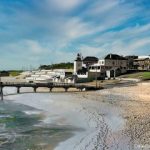
My photo of Helmsley Square taken more recently….remarkably, the buildings in the painting are still there and recognisable.

YORKSHIRE – Painted and Described is available as a downloadable eBook in the eBook Store here.

FLY-SIZE MOTOR

FLY-SIZE MOTOR RUNS (1937)

So tiny that it rests easily on a finger nail, an electric motor constructed by an Italian youth weighs less than an ounce. The Lilliputian power plant has forty-five Parts and develops about eight-one-thousandths of a horsepower.

Kurt Singer – a Jewish resister

Kurt Singer (1885-1944) was a conductor, musician, musicologist, and neurologist. Though described by his daughter Margot Wachsmann-Singer as ‘more German than the Germans,’ he was dismissed as a Jew from his roles in Germany’s musical life after Hitler’s takeover in 1933. He then turned to ‘Jewish’ undertakings and from 1933-1938 led the Berlin Jüdischer Kulturbund (Jewish Culture League), an organization devoted to Jewish culture performed by and for Jews. This organization, which existed from 1933-1941, was at the centre of Singer’s life and death.

The son of a rabbi, Singer was born on 11 October 1885 in Koblenz. He studied medicine and musicology in Berlin, where he became a neurologist. Combining his interests in medicine and music, in 1912 he founded the ‘Berliner Aerztechor’ (Doctor’s Choir), which he also conducted. During World War I, he was a military doctor, earning an iron cross for his service. After the war, he acted as music editor for the Berlin newspaper Vorwärts, the central organ of the Social Democratic Party of Germany. He also wrote and published such works as Wesen und Heilwirkung der Musik (The Healing Power of Music) as well as Berufskrankheiten der Musiker (The Occupational Illness of Musicians), and produced valuable research on German folk song and the composers Richard Wagner and Anton Bruckner. In 1927, his diverse musical accomplishments earned him a post as Intendant of the Städtische Oper (Municipal Opera House) in Charlottenburg, Berlin, under Heinz Tietjen.

When the Nazis came to power, Singer lost this position. One of the regime’s earliest decrees was the Gesetz zur Weiderherstellung des Berufsbeamtentums (Law for the Restoration of the Professional Civil Service) of 7 April 1933, passed six days after the boycott of Jewish businesses. By means of the Law’s Aryan paragraph, ‘civil servants who are not of Aryan ancestry’ were to be dismissed. This measure prevented non- Aryans from holding positions in the public sphere, especially at cultural institutions such as state-run music conservatories, opera houses, concert halls, and theatres. In response to such Nazi legislation, rising anti-Semitism, and simple mathematics (Berlin had a significant Jewish population), Kurt Baumann, who had worked as Singer’s assistant at the Municipal Opera House from 1930-1932, drafted a detailed proposal for a Jewish cultural association and contacted Singer. Baumann was wise to contact Singer. Singer had envisioned a similar organization and – as a combat veteran and respected figure in German national circles – was the perfect spokesperson for such an endeavour. Baumann and Singer revised the initial proposal for the League, and then recruited other Jewish leaders, such as Berlin’s chief rabbi Leo Baeck, journalist Werner Levie, and conductor Joseph Rosenstock, who had been removed from his post as music director at the National Theatre in Mannheim. When Baumann approached theatre critic Julius Bab with the project, Bab was justifiably skeptical: ‘Are we allowed to do this?’ Indeed, it was not clear how the organization would win the Nazi government’s sponsorship.

A born leader, Singer has been described as charismatic and a ‘great personality.’ He drew on these attributes as he struggled to generate interest within various government offices. He was eventually invited to meet with Hans Hinkel, who had been appointed head of the Prussian Theatre Commission by the new Prussian minister Hermann Göring immediately after Hitler’s ascension to power. In April 1933, Hinkel began negotiating with Singer the operating terms for the creation of the Kulturbund. In the middle of May, Hinkel summoned Singer to a final meeting with Göring, who warned: ‘If all of you do everything right and obey Herr Hinkel, then everything will go well. If all of you behave badly, then there’ll be trouble, you know that.’ In this way, the Kulturbund received the Nazi government’s ‘blessing,’ and one of the most paradoxical partnerships in German history began.

During the Kulturbund’s tenure, Singer did his best to meet the various demands of the heterogeneous Jewish community involved through a repertoire both familiar and ‘Jewish.’ He also struggled to maintain the organization despite economic hardships and emigration. To do this, Singer turned to Kurt Sommerfeld, a former musician in the Kulturbund, who had left the ensemble in 1936 to participate in the newly formed Palestine Orchestra. In a letter of 1937, he asked Sommerfeld to help prevent additional musicians from emigrating to join the Orchestra. Though Singer generally helped Kulturbund members leave Germany, Singer’s devotion to the Kulturbund at times bordered on delusional as conditions for Jews in Germany worsened. This detachment from reality became more dangerous in the following year.

In 1938, Singer travelled to the United States, where he visited his sister and lectured at Harvard University. Ernest Lenart, the Tempelherr in the League’s inaugural performance (1933) of Lessing’s Nathan the Wise and an émigré since 1938, visited Singer during his trip. Lenart told him about Kristallnacht, the catastrophic pogroms of November 9-10, and urged him to remain in America. Singer replied: ‘Dear Lenart, I must go back.’ Despite being offered a university position during his stay in the United States, out of loyalty and the importance he placed on the Kulturbund, Singer refused. Upon hearing news of Kristallnacht, he returned to Europe to, in his own words, ‘rescue what could be rescued.’ En route in Rotterdam, friends and acquaintances were able to intercede and persuade Singer to suspend his homecoming. Within a few days, he believed the Kulturbund could no longer function in Nazi Germany. He remained in Holland and, until he realized the severity of the situation, participated, to a limited extent, in musical activities there, including concerts at the Joodsche Schouwburg (Jewish Theatre), which the Nazis established in 1941 on the model of the Berlin Jewish Culture League. With the Nazi occupation of Holland, Singer tried to return to the United States, eventually pinning all his hopes on a non-quota-visa. But no means of escape was forthcoming. On 15 July 1942, the first deportations from Amsterdam to Auschwitz began. Between August 1942 and November 1943, the Jewish Theatre, of all places, was used as a deportation centre and Jews in the region, including Singer, reported there to await transport. Because of his ‘outstanding service to Germany’s artistic community,’ Singer was sent to the ‘model’ concentration camp Terezín, where he died in January 1944. On 11 October 1997, a memorial tablet was erected in Singer’s honor on Mommsenstrasse in Charlottenburg.

By Lily E. Hirsch
http://holocaustmusic.ort.org

Street Scenes in Perth, Western Australia 1907

Entrepreneur Leonard Corrick’s camera moves up and down the streets of Perth recording the action on the street. At one point a man bumps into another man in the street and fisticuffs ensue as the camera moves past.

New Zealanders Albert and Sarah Corrick and their eight children burst onto the Australasian variety performance circuit in 1897. The Corrick Family Entertainers, later known as the Marvellous Corricks, promised regional and metropolitan audiences wholesome family fare spiced with ‘Vim, Verve, Vivacity, Variety’.

Video – Perth 1907

ANZAC – Australia’s youngest casualty

James Charles (Jim) Martin (3 January 1901 – 25 October 1915) was the youngest Australian known to have died in World War I. He was only 14 years and nine months old when he succumbed to typhoid during the Gallipoli campaign. He was one of 20 Australian soldiers under the age of 18 known to have died in World War I.

James Martin was born to Amelia and Charles Martin on 3 January 1901. His father was born Charles Marks, in Auckland, New Zealand however, after emigrating to Australia and settling in Tocumwal, New South Wales, he changed his name to Martin to avoid discrimination for being Jewish. Charles worked as a grocer, handyman and (horse-drawn) cab driver. His mother, Amelia, was born in Bendigo in 1876 to Thomas and Frances Park. Her parents had emigrated to Australia during the gold rush in the 1850s. The youngest of twelve children, she married Charles just before her 18th birthday.

Martin’s family moved to many different suburbs in and around Melbourne before finally settling in Hawthorn in 1910. Born in Hawthorn, he was the third of six children, and the only son. He attended Manningtree Road State School from 1910 to 1915, during which time he also received basic military training as a junior cadet under the compulsory training scheme.

At the outbreak of World War I Martin enlisted in the Australian Imperial Force on 12 April 1915, against the wishes of his family. His parents finally agreed however when he made it clear that he would sign on under an assumed name and never write to them if they did not consent. He gave a false date of birth to the recruiting officer, claiming to be 18, when he was actually 14 years and three months.

Martin joined the 1st Reinforcements of the 21st Battalion as a private and trained in Broadmeadows and Seymour (later Puckapunyal) camps in Victoria before boarding HMAT Berrima in June 1915 to deploy to Egypt. In late August, he was sent to Gallipoli on the steamer HMT Southland, to take part in the fighting against the Turks. En route, his ship was torpedoed by a German submarine off the island of Lemnos and he was rescued after spending four hours in the water. After being picked up, Martin rejoined his battalion at Mudros Island where they were transferred to the transport ship Abassieh on 7 September.

The following morning, just before 2:00 am, Martin’s platoon, 4 Platoon, landed at Watson’s Pier in Anzac Cove. He then served in trenches around Courtney’s Post, which was positioned on the ridge overlooking Monash Valley. During this time he wrote to his family telling them that “the Turks are still about 70 yards (64 m) away from us” and asked them not to worry about him as “I am doing splendid over here”. Throughout his time in Gallipoli, although his family were writing to him, Martin did not receive any letters from home due to a breakdown in the mail system.

Following a period of cold temperatures and heavy rain Martin contracted enteric fever (typhoid) in the trenches. After suffering mild symptoms for about a fortnight during which time he refused treatment, he was subsequently evacuated to the hospital ship Glenart Castle on 25 October 1915 after he developed diarrhoea. He died of heart failure that night, at the age of 14 and nine months, and was buried at sea the next day. At the time of his death only Martin’s parents and his best friend, Cec Hogan—who was himself only 16—knew Martin’s real age. Nevertheless, on 18 December 1915, Melbourne’s Herald newspaper reported Martin’s death in an article titled “Youngest Soldier Dies”.

Martin was awarded the 1914–15 Star, the British War Medal, and the Victory Medal. His name is recorded on the Australian memorial at Lone Pine and on the Australian War Memorial roll of honour in Canberra.